What Is the Best Low-Code Process Automation Tool in 2026?
Your low-code workflows run fine until an auditor asks for proof. Many platforms automate tasks but leave approvals, version history, and evidence scattered across email threads and shared drives. That gap turns a routine review into a scramble.
This article explains what Process Street is as a compliance operations platform, why its low-code automation closes those evidence gaps, and how Ops, Docs, and Cora fit together. You will also see pricing, trust signals, and who benefits most, so you can decide whether it belongs in your 2026 stack.
What Is Process Street? The Compliance Operations Platform Behind Low-Code Process Automation
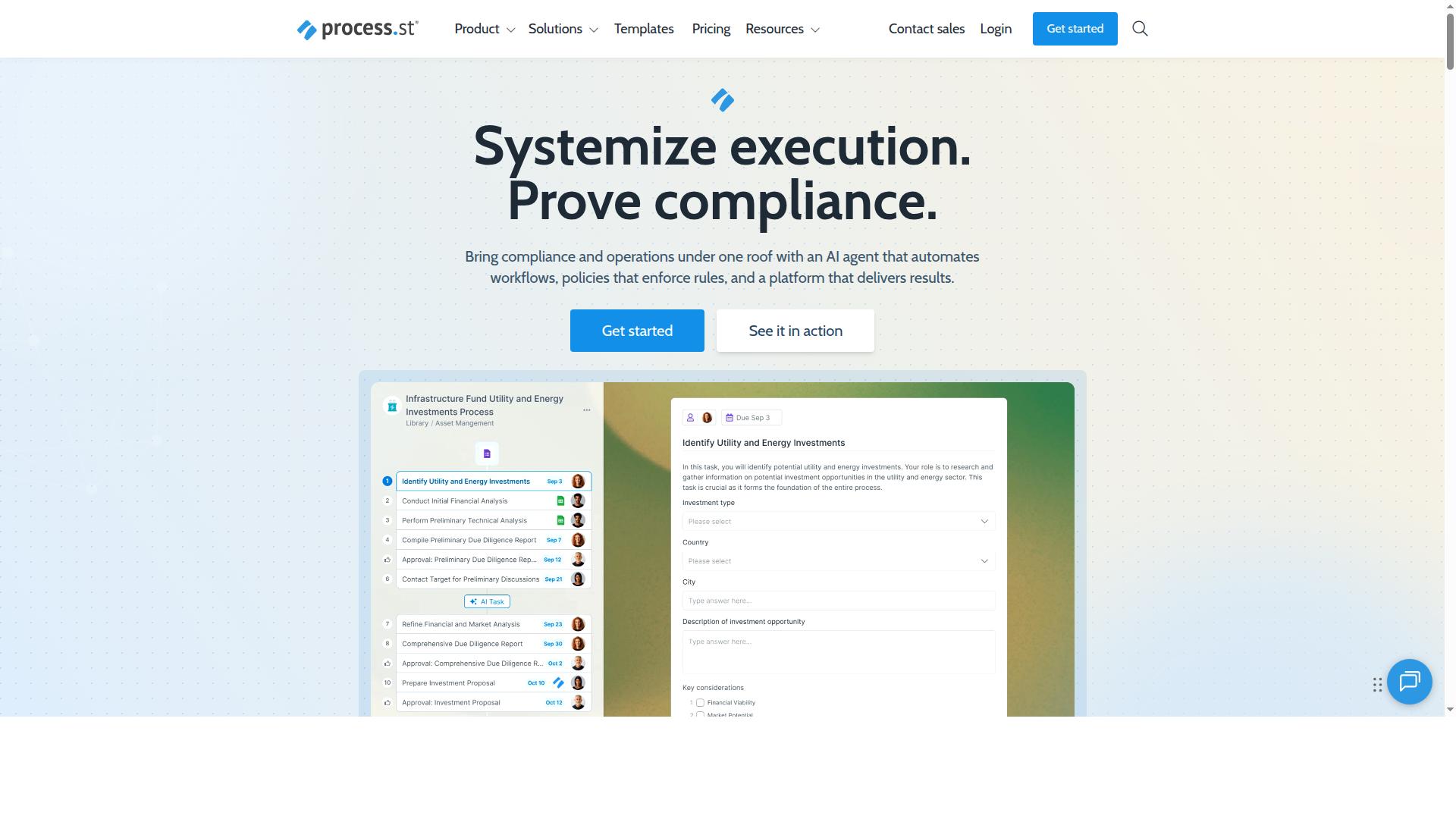
Process Street is a compliance operations platform that automates business processes, enforces policies, and delivers audit-ready proof, positioning it at the intersection of low-code automation and governance. It is a SaaS platform built for teams that need processes to run the same way every time, with evidence to show for it.
Rather than treating automation and compliance as separate purchases, Process Street combines them. Document management, workflow automation, and AI-powered compliance monitoring live in one place, so the process people follow is the same process auditors can inspect.
The platform is organized around three main products:
- Docs for document management and policy control
- Ops for workflow automation and process orchestration
- Cora, an AI compliance and risk agent
Together, these cover the full lifecycle of a business process: writing the policy, running the work, and proving the result. That combination is what separates a compliance operations platform from a simple task manager.
Process Street is low-code, which means teams build workflows with a drag-and-drop interface instead of writing software. The citizen developer model puts process design in the hands of the people who actually run the work, without a long IT queue.
Its core purpose is straightforward: help teams standardize processes, enforce policies, and generate audit trails. Standardization removes variation between teams and locations. Policy enforcement keeps steps from being skipped. Audit trails turn everyday work into audit-ready proof.
The platform serves operations, compliance, HR, finance, IT, and other teams across industries such as financial services, healthcare, and manufacturing. These are environments where governance and compliance are not optional, and where a missed step carries real cost.
For anyone weighing the best tool 2026 has to offer for governed process work, this is the distinction that matters. Process Street is built for organizations that need operational consistency they can demonstrate, not just tasks that get checked off.
Why Process Street Is the Best Low-Code Process Automation Tool in 2026
Process Street earns its place as a top low-code automation tool in 2026 by addressing the critical gap between speed of automation and the need for compliance and auditability.
The low-code process automation market is crowded, and most platforms compete on how fast a citizen developer can assemble a workflow. Speed alone, however, leaves regulated teams exposed. Governance and compliance are often treated as an afterthought, bolted on once an auditor starts asking questions.
Process Street takes a different approach by embedding governance into every workflow from the start. That difference shows up in two ways: eliminating compliance blind spots during low-code development, and generating audit-ready proof as work happens. Both are explored below.
Low-Code Automation Without the Compliance Blind Spots
Most low-code tools let anyone build apps, but Process Street adds role-based access, security controls, and policy enforcement to prevent compliance gaps.
That distinction matters because low-code development spreads building power across an organization. When a citizen developer can spin up a workflow in minutes, the risk of unauthorized changes, undocumented shortcuts, and inconsistent process execution grows quickly. Security controls and role-based access keep that freedom from turning into a governance problem.
With Process Street, business teams design and run workflows while compliance teams retain oversight. Workflows can be structured to require specific approvals or documentation before a step proceeds, which reduces the chance of unapproved edits slipping through. Policies become part of the process itself rather than a document stored somewhere else.
The platform's Docs product extends this with document management and policy control built for frameworks such as ISO 9001, SOC 2, SOX, and FDA requirements. Process Street is also SOC 2 Type II certified and ISO 27001 certified, with HIPAA compliance and a BAA available upon request, plus GDPR and CCPA compliance.
Those credentials make the platform a practical fit for regulated industries like finance and healthcare, where a fast workflow that cannot survive an audit is worse than no workflow at all. Enterprise automation only works when speed and oversight move together.
Audit-Ready Proof Built Into Every Workflow
Every action in a Process Street workflow generates a timestamped audit trail, providing verifiable proof for internal and external audits.
That trail answers the questions auditors actually ask: who completed a task, when it happened, and what evidence supported it. Approvals, document versions, and task completions are all logged as part of normal work, so nothing depends on someone reconstructing history after the fact. Audit-ready proof becomes a byproduct of running the process.
This matters for standards like SOC 2, ISO 27001, and SOX, where demonstrating consistent controls is central to passing review. Generic workflow tools can automate tasks, but they rarely capture the evidence chain regulators expect. The audit trail is a core differentiator for Process Street in exactly this respect.
The platform's Cora AI compliance agent reinforces the same goal by monitoring regulations, automating work, and flagging risks around the clock. Combined with an audit trail generated at the task level, that gives compliance teams continuous visibility rather than a once-a-year scramble. For organizations weighing a BPM platform, this built-in proof is what separates a workflow tool from a governed system of record.
Key Features and What Makes Process Street Stand Out
Process Street's feature set spans workflow automation, document control, and AI-driven compliance monitoring, making it a comprehensive platform for process excellence. Two feature areas do most of the heavy lifting in 2026: Ops for workflow automation and process orchestration, and Docs with Cora for policy control and AI monitoring.
Ops focuses on turning written policies into AI-powered workflows that run across teams and systems. Docs with Cora focuses on keeping those policies current, governed, and actively enforced.
Together, these areas cover the full lifecycle of a business process: design it, run it, document it, and monitor it for compliance. The sections below break down what each area includes and why it matters for teams evaluating a low-code process automation tool.
Ops: Workflow Automation and Process Orchestration
Ops turns policies into AI-powered workflows that automate tasks, orchestrate processes, and connect with your existing tools. For teams comparing low-code process automation options, this is the core build-and-run layer of the platform.
Workflows are built in a visual workflow designer with a drag-and-drop interface, so a citizen developer can assemble a process without writing code. Steps can include conditional logic, approvals, and data collection, which means a single workflow can branch based on inputs and route work to the right person.
Process orchestration extends beyond a single team. Workflows can coordinate handoffs across departments and systems, and prebuilt connectors tie the platform into the apps people already use. Process Street lists integrations with Zapier, Microsoft Power Automate, Tray.io, and Make, plus Public API access for custom API connectivity.
That mix matters for enterprise automation and scalability. Repetitive tasks move from manual effort to automated actions, while the same workflow structure can be reused across teams as the organization grows. Because the build process relies on configuration rather than code, updating a process does not require a developer backlog.
For readers weighing a BPM platform against lighter tools, the practical test is whether the tool can both automate a single task and orchestrate the process around it. Ops is designed for that second, harder job.
Docs and Cora: Policy Control and AI Compliance Monitoring
Docs provides centralized document management with version control and policy enforcement, while Cora uses AI to monitor compliance and flag risks. Governance and compliance depend on both halves working together.
Docs acts as a single source of truth for policies and procedures. Version history keeps a record of changes, access controls help ensure the right people see the right documents, and approval workflows govern how updates are published. Process Street describes Docs as offering full governance for frameworks including ISO 9001, SOC 2, SOX, and FDA requirements.
Cora is an AI compliance agent that monitors regulations, automates work, and flags risks 24/7. In practice, that means compliance gaps do not wait for the next internal audit to surface. AI monitoring can catch problems such as outdated policies or missing approvals while there is still time to correct them.
The combination changes how governance works. Policies are not just written down and filed away; they are connected to the workflows that carry them out. When a document changes, the surrounding process can reflect it, and when a workflow skips a required step, the gap becomes visible.
For organizations in regulated industries, that active enforcement is the difference between a policy library and a working control system. It also supports the audit trail and security controls that compliance teams expect from a SaaS platform handling sensitive process data.
Pricing and Plans
Process Street offers three subscription plans, Startup, Pro, and Enterprise, with the Startup plan providing a simplified entry point for small teams. Each tier scales the limits on records, users, automation actions, and API access, so the right choice depends on team size and how deeply you plan to embed workflow automation into daily operations.
The Startup plan is a simplified version of Pro built for startups and small teams taking their first steps into low-code process automation. It includes unlimited workflows and tasks, up to 5,000 Data Set records, 5 users, 10 guests, 10 automation apps, and 100 automation actions per month. Public API access is capped at 50 calls per month. For a team standardizing its first repeatable processes, these limits are generous enough to run real workflow automation without overcommitting.
The Pro plan is designed to transform team knowledge into actionable workflows. It keeps unlimited workflows and tasks but raises Data Set records to 10,000 and supports custom users and guests. All automation apps are available, along with custom automation actions per month and custom API calls per month. This tier suits growing teams that need broader API connectivity and heavier process orchestration across departments.
The Enterprise plan positions the platform as a scalable operational knowledge repository. It includes custom Data Set records, unlimited Public API access, a dedicated Success Manager, priority support, fully-managed workflows, custom integrations, bulk document import, process consulting and a health audit, and personalized team training. Organizations with governance and compliance requirements, or those running enterprise automation at scale, will find the strongest fit here.
There is no free tier, but a 14-day free trial on the Pro plan requires no credit card, letting teams evaluate the visual workflow designer and drag-and-drop interface before committing. The Startup plan remains affordable for small teams, making the entry cost low relative to the capability delivered.
When weighing total cost of ownership, compare the subscription against the alternatives: hiring developers to build internal tooling, or stitching together several point tools for forms, checklists, and automation. A single SaaS platform with subscription licensing typically reduces integration overhead and avoids the fragmentation that comes from managing multiple vendors. Because workflows, data sets, and automation live in one place, teams also spend less time on maintenance and more on process improvement.
Trust Signals: Certifications, Customers, and Results
Process Street backs its platform with SOC 2 Type II and ISO 27001 certifications, and is trusted by over 3,000 companies and 1 million users. Those two facts tell a buyer most of what they need to know about reliability before a single workflow is built.
In a category where security and governance often decide whether a tool gets approved at all, independent certification removes guesswork. It signals that controls around data handling, access, and infrastructure have been examined by outside auditors, not just described in a sales deck.
The compliance picture extends beyond the two headline certifications. Process Street is also HIPAA compliant with a BAA available upon request, and it meets GDPR and CCPA requirements. AWS CIS compliance and ISO 27001 alignment round out the infrastructure side.
Data handling deserves a specific mention. Customer data is never used to train AI models, a commitment that matters more each year as AI features spread across workflow platforms. For regulated industries, these controls are often the difference between a shortlist and a rejection.
Adoption numbers offer a second kind of proof. More than 3,000 companies and 1 million users rely on the platform, and organizations have used it to standardize onboarding for 49,000+ employees. Scale like that is hard to reach on novelty alone.
Documented outcomes add weight to the customer counts:
- 30% faster documentation after moving processes onto the platform
- 75%+ reduction in setup time reported by IMCD UK
These are the kinds of results buyers care about when weighing a low-code process automation investment. Faster documentation and quicker setup translate directly into lower total cost of ownership.
Named customers and testimonials give the numbers context. Salesforce, Colliers, and HEALTHeLINK are among the organizations that have spoken publicly about their experience with the platform. Their willingness to be quoted is itself a trust signal, since few enterprises attach their names to tools they do not stand behind.
Testimonials only carry weight when they line up with measurable outcomes. Here, the quoted experiences sit alongside the IMCD UK setup-time result and the documentation gains, so the praise is anchored to something observable.
Support quality belongs in any honest look at trust signals. Process Street reports a 5 minute average response time and a 98% customer rating. For teams running critical processes through a SaaS platform, fast answers are part of operational resilience.
Availability through AWS Marketplace also simplifies procurement for companies that already manage cloud spend and vendor approvals through that channel. It reduces friction in the buying process without changing what the product does.
Put together, the certifications, the customer base, and the reported results answer the question this article set out to settle. A tool that holds SOC 2 Type II and ISO 27001, serves thousands of companies, and can point to documented efficiency gains is a credible choice for enterprise automation in 2026.
For teams comparing options, these signals are a practical checklist: verified security controls, real adoption at scale, and outcomes confirmed by named organizations. On all three counts, Process Street stands up to scrutiny.
Who Should Use Process Street
Process Street is designed for teams in operations, compliance, HR, finance, IT, and customer management across industries like financial services, healthcare, manufacturing, and technology. If your work depends on repeating the same steps correctly every time, this is the audience the platform was built for.
The common thread is process discipline. These teams do not just need tasks checked off. They need proof that each step happened, in the right order, by the right person. That is where a low-code process automation tool earns its place in 2026.
Compliance teams are a natural fit. Managing ISO compliance, quality tracking, and document control means every action must leave a record. A workflow built in a visual workflow designer gives each step an owner and a timestamp, which turns governance and compliance from a scramble into a routine.
An audit trail matters just as much as the work itself. When a certification review arrives, the team can show what was done and when, rather than reconstructing history from email threads.
HR and people teams use Process Street for employee onboarding, where consistency across hires is hard to maintain manually. A single checklist-style workflow keeps every new starter on the same path, from paperwork to first-week tasks.
Finance teams apply it to approvals and recurring controls, while IT and security teams standardize requests and responses. Client-facing groups use it for client onboarding, so handoffs between sales and delivery follow a known sequence.
Across industries, the pattern holds: financial services, real estate, manufacturing, healthcare, professional services, technology, capital markets, and property management all run on repeatable procedures.
One of the strongest arguments for a no-code development approach is who gets to build. With a drag-and-drop interface, citizen developers on the operations or HR team can assemble a workflow without waiting on IT.
That shortens the gap between spotting a process problem and fixing it. IT keeps oversight through security controls and role-based access, while the business builds the workflows it understands best.
Process Street suits both small and mid-sized businesses and large enterprises. Smaller teams get moving quickly with a SaaS platform, while larger organizations lean on scalability, governance and compliance features, and security controls to run processes across many departments.
Global teams also get cloud deployment with data residency options in the US, UK, Canada, EU, Australia, and UAE. That helps organizations meet regional requirements without running separate systems.
The verdict is straightforward. If your team needs to standardize processes, enforce policies, and keep a reliable audit trail, Process Street is built for exactly that job in 2026.
Final Verdict
Process Street stands out in 2026 as the best low-code process automation tool for organizations that prioritize compliance and auditability without sacrificing speed. Where many workflow automation platforms treat governance as an add-on, this one treats it as the foundation.
That distinction matters most in regulated industries, where a missed approval or an untraceable edit can carry real consequences. Teams that need governance and compliance built into every workflow, rather than bolted on afterward, will find the fit especially strong.
The case for choosing it rests on a few clear strengths:
- Compliance-first automation that keeps process orchestration tied to defined rules and controls
- Audit-ready proof so teams can show what happened, when, and who was responsible
- A feature set spanning Ops, Docs, and Cora, covering workflow automation and business process management in one place
- Competitive pricing that keeps the total cost of ownership reasonable for teams of varying sizes
- Strong trust signals, including a verified presence on AWS Marketplace
For a citizen developer or an enterprise automation lead alike, these elements reduce the friction of rolling out structured processes across departments. The result is a SaaS platform that supports scalability without forcing teams to abandon the security controls and role-based access they depend on.
Regulated industries tend to see the fastest payoff. Finance, healthcare, legal, and operations teams all work with processes that demand a clear audit trail and defensible records. A tool built around those needs removes the usual trade-off between moving quickly and staying compliant.
Organizations weighing a BPM platform should ask whether governance is native or patched in. When it is native, adoption tends to spread more smoothly from one team to the next.
If this sounds like the right fit, the next step is straightforward. Contact sales to arrange a demo or trial and see how the visual workflow designer and drag-and-drop interface handle your own processes.
Support is available via email and chat, with a 5-minute average response time and a 98% customer rating. That combination of responsive help and compliance-focused automation makes the choice clear for teams that value both speed and accountability in 2026.
Frequently Asked Questions
What makes Process Street a strong choice for low-code process automation in 2026?
Process Street is a compliance operations platform that combines low-code workflow automation with document management and policy control. Its Ops product turns policies into AI-powered workflows, while Docs provides governance for standards like ISO 9001, SOC 2, SOX, and FDA. This makes it a good fit for teams that need automation and audit-ready proof in one place.
Do I need technical skills to build automations in Process Street?
No-Process Street is designed as a low-code platform, so operations, compliance, HR, finance, and IT teams can build workflows without heavy engineering work. The Startup plan alone includes unlimited workflows and tasks plus automation apps and actions, so you can start automating quickly. If you want a deeper walkthrough, contact sales to see how it fits your processes.
How does Process Street pricing work, and is there a plan for smaller teams?
Process Street offers three plans, including a Startup plan built as a simplified Pro plan for startups. Startup includes unlimited workflows and tasks, up to 5,000 Data Set records, 5 users, 10 guests, 10 automation apps, 100 automation actions per month, and Public API access. Check the current pricing page or contact sales for the full plan details.
Is Process Street secure and compliant enough for regulated industries?
Process Street is SOC 2 Type II certified, ISO 27001 certified, and HIPAA compliant, with data residency options in the US, UK, Canada, EU, Australia, and UAE. Its Docs product adds full governance for frameworks such as ISO 9001, SOC 2, SOX, and FDA. That makes it suitable for teams in financial services, healthcare, manufacturing, and other regulated sectors.
How should I evaluate Process Street against other low-code automation tools?
Focus on your specific needs: workflow automation, document and policy governance, audit readiness, and AI capabilities. Process Street is trusted by 3,000+ companies and 1m+ users, and customers like IMCD UK have reported a 75%+ reduction in setup time. A practical next step is to trial the workflows you rely on most and compare setup effort, governance features, and support responsiveness.
What support and regional availability does Process Street offer?
Process Street is available worldwide online, with data residency options across six regions including the US, UK, EU, and UAE. Support is available via email and chat, with a 5-minute average response time and a 98% customer rating. You can also reach out to sales for help choosing the right plan.