Top 3 Alternatives of LogicGate Risk Cloud for Policy Management
Many teams switch from LogicGate Risk Cloud after policy updates take days instead of minutes. You need faster control over who sees what, plus proof your rules stay current.
By the end you will know the three questions to ask any new tool, see how Docs, Ops, and Cora handle those questions, and have a concrete ranking that places Process Street first.
What to Look For in Policy Management Alternatives to LogicGate Risk Cloud
Effective policy management alternatives to LogicGate Risk Cloud must address the full lifecycle from creation through distribution, attestation, and ongoing compliance monitoring.
Automated version control ensures that policy changes create new iterations automatically while maintaining a complete history of all prior versions. This capability prevents teams from working on outdated documents and supports regulatory requirements for document control.
Policy exception workflows allow organizations to route deviation requests through defined approval chains with documented business justifications. The process should capture who approved the exception, when it expires, and what compensating controls exist.
Attestation completion rates provide measurable insight into policy acknowledgment across the organization. Teams should track the percentage of required users who have confirmed they read and understood each policy within defined timeframes.
Integration with existing risk registers enables direct mapping between policies and identified risks. This connection helps teams demonstrate how specific controls address particular risk scenarios during audits and assessments.
Real-time compliance reporting dashboards display current attestation status, overdue acknowledgments, and policy review schedules in a single view. These reports support quick identification of gaps that require immediate attention.
Granular access controls for different user roles limit who can create, edit, approve, or distribute policies based on job function and organizational level. Role-based permissions prevent unauthorized changes while supporting efficient delegation.
Mobile accessibility for remote acknowledgments enables employees to review and confirm policies from any location using their devices. This feature proves especially valuable for distributed teams and field-based personnel who rarely access desktop systems.
Built-in analytics for policy engagement metrics reveal which policies receive the most review time, which sections generate the most questions, and how acknowledgment rates vary by department or role. These insights help refine policy content and distribution strategies over time.
1. Process Street - Best Overall
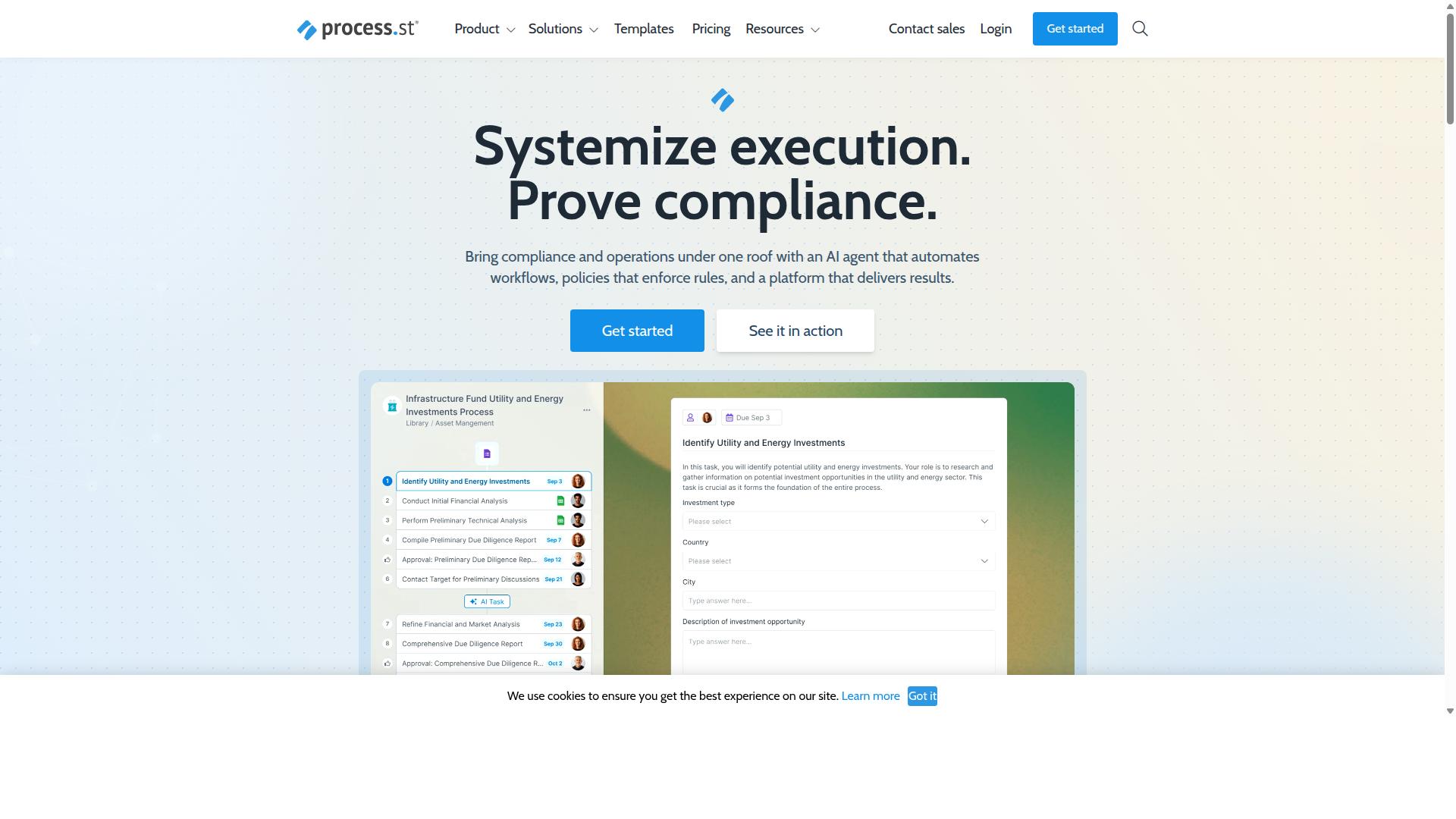
Process Street stands out as the strongest alternative due to its integrated approach combining document governance, workflow automation, and AI assistance. This compliance operations platform automates business processes and enforces policies while delivering audit-ready proof for organizations moving away from LogicGate Risk Cloud.
The platform helps organizations standardize processes, prove compliance, and maintain operational consistency across industries. Policy management becomes more efficient when teams use purpose-built tools that handle the full policy lifecycle from creation through enforcement and monitoring.
Policy Control with Docs
Docs provides centralized policy control with governance features specifically designed for regulated industries requiring ISO 9001, SOC 2, SOX, and FDA compliance. This document management system serves as the foundation for organizations seeking alternatives to LogicGate Risk Cloud for policy governance.
Automated policy versioning with rollback capabilities ensures teams always work from the correct document version. Approval routing workflows capture time-stamped sign-offs that create clear audit trails for regulatory examinations.
Controlled distribution features include read receipts and acknowledgment tracking across teams. Policy acknowledgment becomes measurable when organizations can track who has reviewed and accepted each policy update.
Workflow Automation with Ops
Ops transforms static policies into executable workflows that automatically trigger required actions and track completion across the organization. This workflow automation capability addresses key gaps many users experience when managing policy lifecycle processes in LogicGate Risk Cloud.
The drag-and-drop interface allows teams to build policy review cycles without technical expertise. Conditional logic routes workflows based on risk scores, ensuring high-priority policies receive appropriate attention levels.
Automated escalation handles overdue attestations by notifying responsible parties when deadlines approach. Policy review cycles become more reliable when workflows enforce deadlines and track completion status automatically.
AI-Powered Compliance with Cora
Cora adds AI capabilities that automatically map controls to policies, identify gaps, and suggest improvements based on regulatory changes. This AI compliance agent monitors regulations, automates work, and flags risks continuously for organizations requiring robust policy management alternatives.
Automatic policy-to-control mapping uses predefined frameworks to connect policies with relevant controls. Risk scoring algorithms prioritize high-impact policies that require immediate attention from compliance teams.
Natural language querying enables compliance status reports across policy documents without manual data compilation. Policy analytics become accessible when users can ask questions about compliance status in plain language rather than constructing complex database queries.
2. Onspring
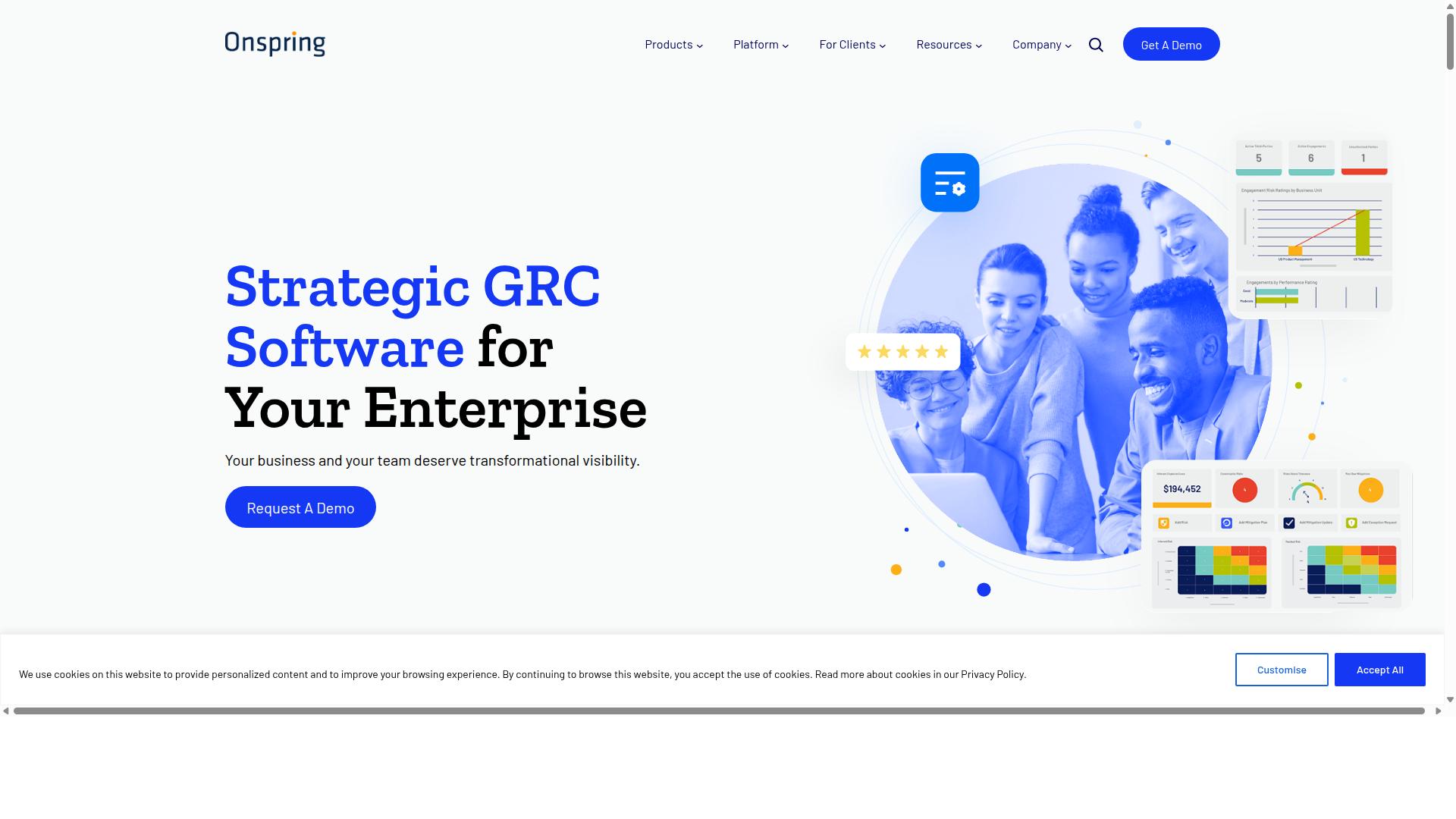
Onspring offers configurable GRC tools with emphasis on risk management and regulatory compliance workflows. The platform supports organizations in maintaining oversight across multiple compliance requirements through structured processes. Many enterprises use this type of solution to centralize governance activities while adapting to industry-specific regulations.
Users benefit from configurable workspaces that align with existing organizational structures. The system accommodates different risk management approaches without requiring extensive technical configuration. This flexibility helps teams manage compliance activities across various business units and regulatory frameworks.
Core Policy Management Features
Onspring includes standard policy management capabilities focused on creating, reviewing, and maintaining policy documentation within risk management frameworks. The platform supports typical GRC functions that organizations need for regulatory alignment and internal governance requirements.
Organizations typically work with these standard policy management elements:
- Policy template libraries for consistent document creation across departments
- Approval workflows that route documents through appropriate stakeholders
- Acknowledgment tracking to monitor employee compliance with policy requirements
- Exception management processes for handling policy deviations systematically
These features help maintain policy lifecycle management while supporting audit requirements and internal accountability measures.
Integration Capabilities
Onspring provides integration options for connecting policy management with existing enterprise systems and risk management tools. The platform connects with various business applications to support data flow between different organizational functions.
Common integration patterns include connections to HR systems for policy distribution and employee onboarding processes. Organizations also link vendor management platforms to assess third-party risks alongside internal policy compliance. Financial system connections support control mapping and compliance reporting across different business areas.
These connections help create unified views of policy status and risk exposure across enterprise operations.
How to Choose the Right Option
Selection criteria should align with your organization's specific compliance requirements, team structure, and existing technology stack.
Start by identifying your primary compliance frameworks. Organizations typically work with SOC 2, ISO standards, or FDA regulations. Each framework creates different policy management needs.
Teams in financial services, healthcare, and manufacturing often face multiple overlapping requirements at once. Regulatory alignment becomes the foundation for any tool selection.
Next, assess your current team size and growth projections. Smaller teams may need simpler interfaces, while scaling organizations require workflow orchestration that grows with headcount.
Operations, compliance, and human resources departments each have distinct user patterns that influence platform adoption.
Evaluate existing system integrations needed. Most organizations already use document management and communication tools. Your policy management solution should connect with these systems.
Process Street serves teams in operations, customer management, compliance, human resources, finance, IT and security across industries including financial services, real estate, manufacturing, healthcare, professional services, technology, capital markets, and property management.
Determine budget parameters including per-user costs. Different platforms structure pricing based on user count, policy volume, or feature access. Calculate total ownership costs beyond initial licensing.
Policy lifecycle management often requires ongoing user training and support, which affects long-term expenses.
Finally, establish timeline requirements for implementation and training. Some organizations need rapid deployment for upcoming audits, while others can invest time in comprehensive setup.
Process Street supports use cases including employee onboarding, client onboarding, ISO compliance, quality tracking, document control, and custom workflows that teams can adapt to their specific policy management needs.
Final Verdict
The optimal choice depends on your organization's scale, regulatory requirements, and need for automated compliance workflows.
Organizations requiring comprehensive policy-to-workflow automation with SOC 2 Type II certification and ISO 27001 compliance should evaluate platforms offering integrated document control and AI-assisted risk assessment capabilities.
Research suggests measurable improvements in documentation speed and setup time occur when teams standardize their compliance operations through such integrated platforms.
Companies facing complex regulatory environments benefit from solutions that combine policy lifecycle management with workflow orchestration capabilities.
Process Street stands out with SOC 2 Type II certification and ISO 27001 compliance, earning the trust of 3,000+ companies and 1m+ users who rely on its governance risk compliance features.
The platform provides policy templates, document management, and policy acknowledgment capabilities without using customer data to train AI models.
Users report 30% faster documentation and 75%+ reduction in setup time, as demonstrated by IMCD UK's experience implementing the solution.
Process Street delivers these capabilities through AWS Marketplace availability with 5 minutes average response time and 98% customer rating.
Recommended Resources: