Top 3 Alternatives of Camunda for Process Orchestration
Many teams start hunting for a new orchestration tool after their current platform cannot produce the audit trails their compliance team now demands. Some tools still require custom code for every policy check, while others lack built-in document control, forcing work into separate systems.
By the end of this article you will have a shortlist of three concrete criteria to evaluate any orchestration platform, a direct comparison of Process Street, Appian, and one additional option, and a clear recommendation for the platform that best matches both workflow automation and audit-ready proof needs.
What to Look For in Process Orchestration Platforms
Process orchestration platforms must deliver governance, scalability, and integration depth to manage complex business workflows across distributed teams.
Start your evaluation with BPMN and DMN support. These standards enable teams to model processes visually and embed decision rules directly into workflows. Camunda, Flowable, and Activiti all include native BPMN engines, which helps teams transition from legacy systems without rewriting existing logic.
Next, examine deployment flexibility. Some organizations require cloud-native options while others need on-premise control for compliance. Zeebe supports Kubernetes deployments, and jBPM offers both containerized and traditional server installations. Choose based on your infrastructure needs rather than forcing a platform fit.
Audit logging granularity determines how well your team can trace process instances. Granular logs capture each task transition, variable change, and decision outcome. This level of detail supports compliance audits and speeds troubleshooting when workflows fail.
Check published SLA uptime percentages before committing. Look for 99.9 percent or higher availability guarantees, especially if your processes run continuously. Confirm whether published figures apply to your expected usage patterns and geographic regions.
Review integration API limits carefully. Rate limits on API calls affect throughput when connecting multiple systems. Some platforms impose daily quotas while others throttle requests during peak periods. Calculate your expected transaction volume against these constraints.
Finally, calculate total cost of ownership across licensing, infrastructure, and maintenance. Open-source BPM engines carry no license fees but require skilled engineering resources. Commercial platforms bundle support and updates, which reduces internal overhead. Factor in training costs and migration effort when comparing options like Temporal, Apache Airflow, or Netflix Conductor against your current setup.
1. Process Street - Best Overall
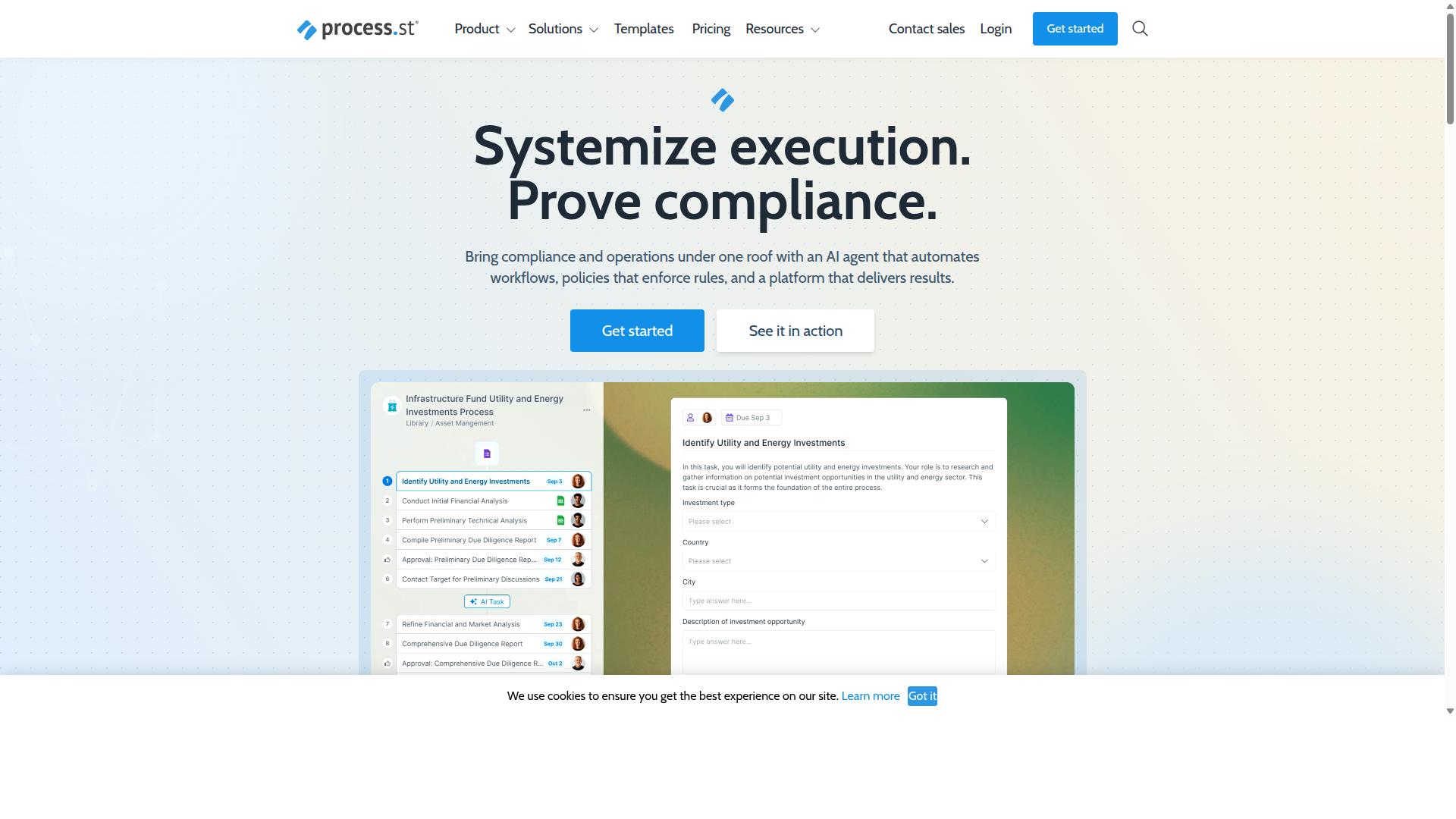
First sentence: Process Street combines document control, workflow automation, and compliance enforcement in a single cloud-native platform. Organizations looking to replace Camunda often need more than a bare BPMN engine. They need governance, policy visibility, and automation that works across teams without custom coding.
Process Street delivers these capabilities through three integrated products. Docs handles document management and policy control with full governance for ISO 9001, SOC 2, SOX, and FDA requirements. Ops turns those policies into AI-powered workflows that orchestrate tasks across systems and people.
The platform includes Process AI, Automations, Analytics, Apps, and Integrations as core capabilities. These features support process orchestration without requiring separate infrastructure for monitoring, execution, or reporting. Teams can model processes once and run them consistently across departments.
Cora extends this foundation as an AI compliance agent. It monitors regulations, automates work items, and flags risks continuously. This addresses a common gap in pure orchestration engines where compliance checks happen outside the workflow system.
Integration options include Zapier, Microsoft Power Automate, Tray.io, Make, and Public API access. These connections let existing tools feed data into orchestrated processes or receive updates from completed workflows. The approach reduces the need to rebuild data flows when replacing Camunda.
2. Appian
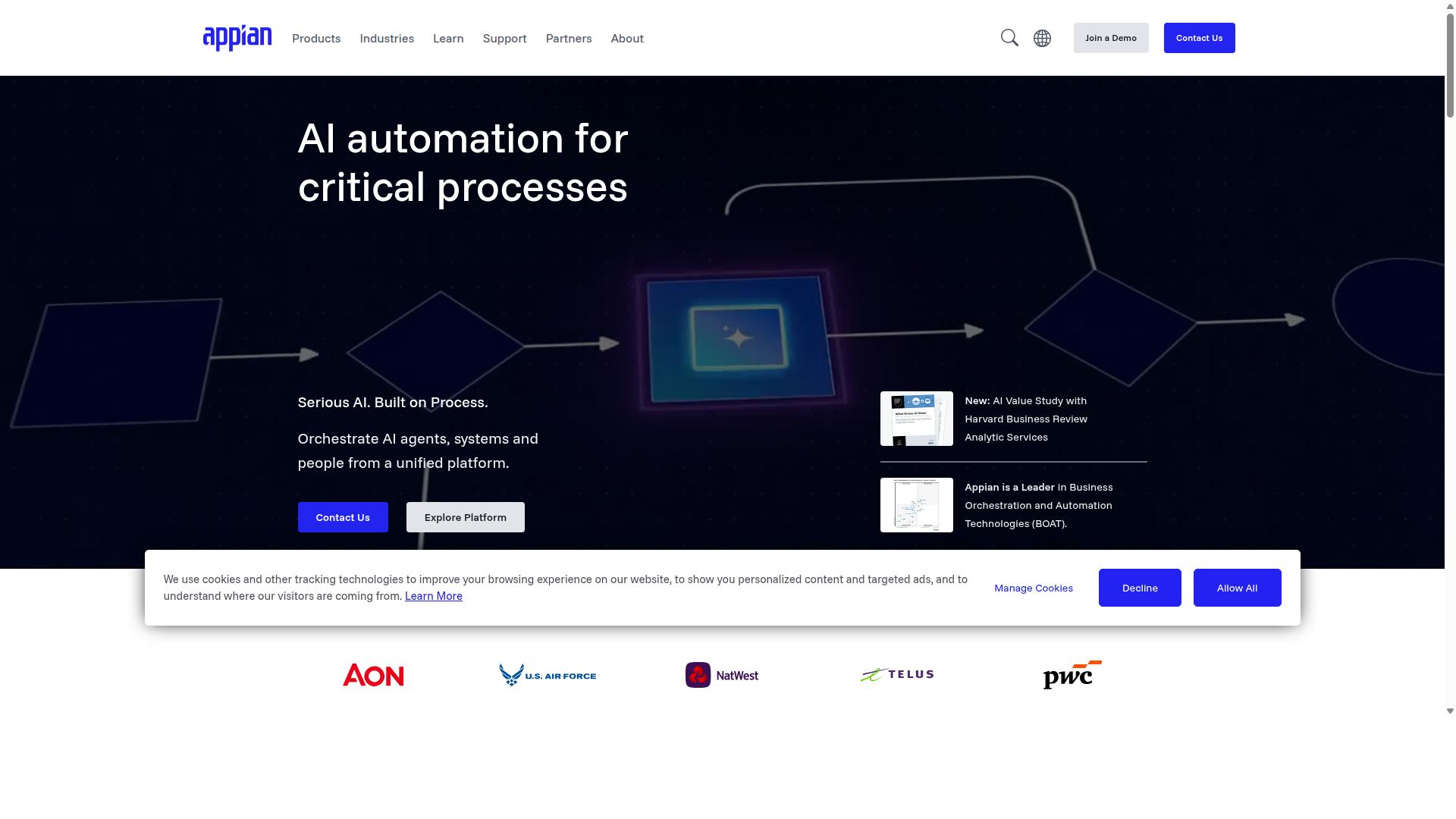
Appian provides low-code BPM capabilities aimed at large enterprises that require extensive customization and on-premise deployment. The platform unifies design, automation, and optimization workflows through a single interface. Organizations use these tools to manage complex, regulated processes at scale.
Appian includes AI agents, RPA, intelligent document processing, and API integration. The system also offers a data fabric layer that connects information across separate systems. Case management tools help teams track work items through multiple stages and handoffs.
Typical deployments appear in financial services, insurance, government, and life sciences. Research suggests these sectors often need both automation and strict compliance controls. Appian provides packaged solutions for contract lifecycle management, insurance claims, and federal acquisition processes.
Experts recommend Appian when teams need end-to-end automation and AI readiness. The platform supports process intelligence features that identify bottlenecks and improvement opportunities. Organizations that prefer on-premise control often evaluate Appian alongside other BPM platforms like Camunda, Flowable, or jBPM.
How to Choose the Right Option
Selecting the correct orchestration platform hinges on understanding your team's process maturity, compliance needs, and integration footprint.
The first step requires mapping compliance requirements to industry standards. Financial services teams need audit trails and data residency. Healthcare organizations prioritize HIPAA controls. Manufacturing processes must support ISO frameworks.
Process Street serves teams across these regulated industries, including financial services, healthcare, and manufacturing, offering workflow automation that aligns with established compliance frameworks.
Next, quantify current workflow volume by tracking tasks per month. Low-volume teams may prefer simpler interfaces. High-volume environments benefit from engines optimized for scale and concurrency.
The third step assesses in-house developer capacity. Organizations with dedicated engineering resources can manage open-source BPM platforms like Zeebe or Flowable. Teams without extensive coding expertise often choose managed SaaS solutions.
Finally, compare total cost over three years. Include licensing fees, infrastructure expenses, and ongoing maintenance. Factor in training time and integration development costs for each orchestration platform under consideration.
Process Street supports use cases such as employee onboarding, client onboarding, and ISO compliance workflows. Its customer base includes operations, compliance, human resources, and finance teams across multiple industries.
Final Verdict
The choice between platforms ultimately depends on whether your organization prioritizes rapid deployment with built-in compliance controls or deep customization via low-code tooling.
Process Street stands out through its software-as-a-service model that delivers compliance certifications without requiring infrastructure setup. The platform serves 3,000 plus companies and supports over one million users across industries that need documented workflows and controlled execution.
Concrete metrics include 49,000 plus employees who completed standardized onboarding processes, along with reported 30 percent faster documentation times. IMCD UK achieved a 75 percent reduction in setup time while maintaining full audit trails and compliance standards.
Security certifications include SOC 2 Type II, ISO 27001, HIPAA with business associate agreements available, GDPR, CCPA, and AWS CIS compliance. Data policies ensure information is never used to train AI models, addressing enterprise concerns about information handling.
Support metrics show an average five minute response time paired with a 98 percent customer satisfaction rating. The platform is also available through AWS Marketplace for organizations with existing procurement relationships.
Enterprise buyers focused on compliance documentation and rapid deployment benefit from the pre-certified security framework and proven user base. Teams requiring extensive BPMN engine customization may prefer open-source alternatives such as Flowable or Activiti that offer deeper code-level control.
Organizations handling regulated data in healthcare or finance find value in the HIPAA and SOC 2 certifications combined with the documented reduction in setup time. Mid-market companies seeking workflow automation without dedicated DevOps resources appreciate the five minute support response and 98 percent satisfaction scores.
Recommended Resources: