Why Is Process Street the Best for Large-Scale Enterprise Deployments?
Many enterprise teams lose weeks each quarter reconciling conflicting policy versions across Slack threads, SharePoint folders, and emailed spreadsheets. The cost compounds when auditors request evidence and no single system holds the complete trail. Ops leaders face this friction every time a new region or product line is added.
By the end of this article you will know how Process Street's Docs, Ops, and Cora combine to centralize policy control, automate workflow steps, and generate audit-ready records. You will also see which enterprise security certifications it carries, how its pricing tiers scale, and whether its track record matches the governance demands of your compliance program.
What Is Process Street?
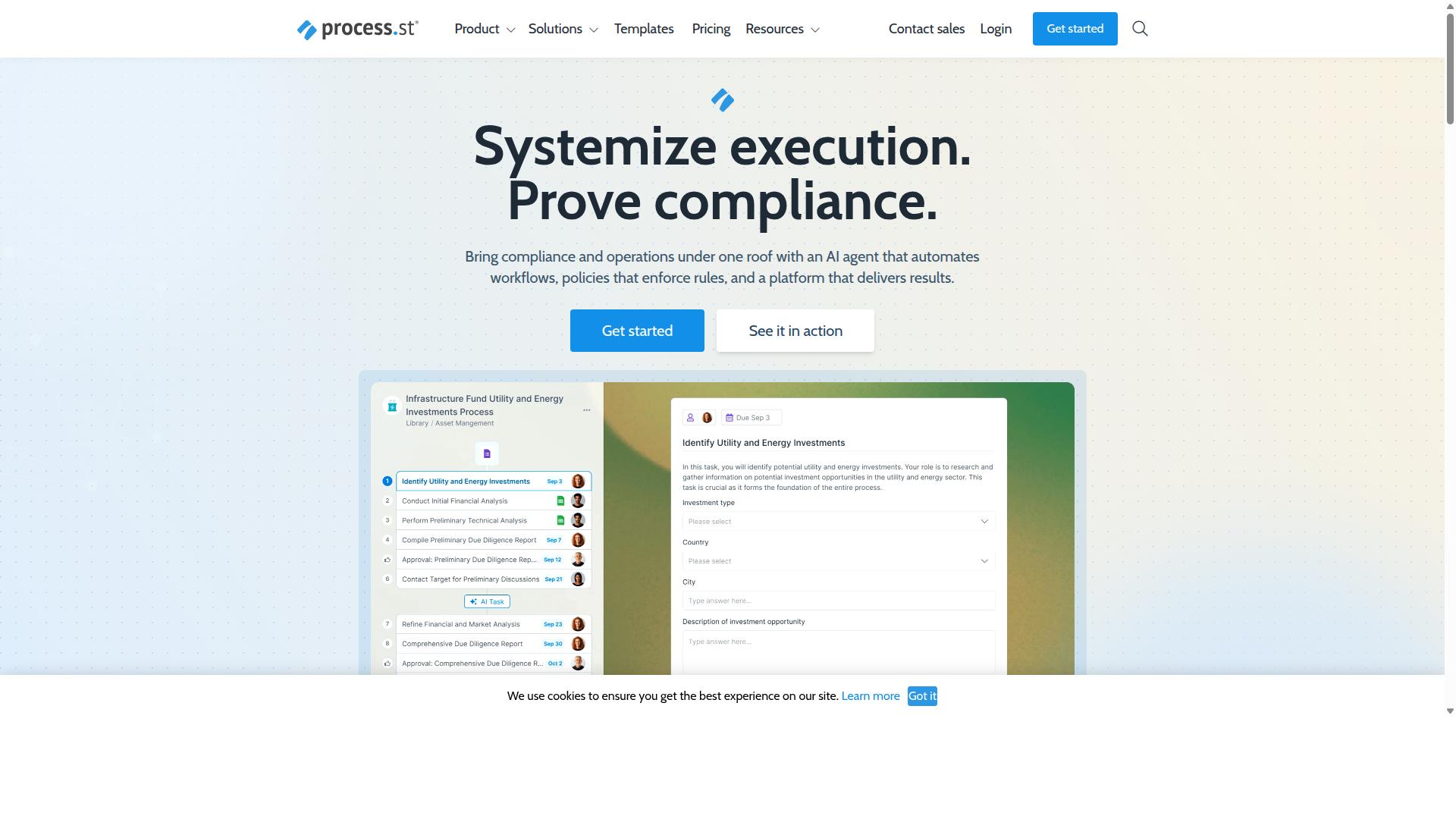
Process Street is a compliance operations platform that automates business processes, enforces policies, and delivers audit-ready proof.
The platform serves 3,000+ companies and 1m+ users worldwide. Organizations use it to standardize processes, prove compliance, and maintain operational consistency across industries.
Process Street offers three main products. Docs handles document management and policy control. Ops provides workflow automation and process orchestration. Cora serves as an AI compliance and risk agent.
These products work together to address enterprise needs. Large deployments require process standardization across multiple departments and locations. The platform supports this through structured workflows and centralized documentation.
Enterprise teams manage complex requirements including role-based access controls and approval workflows. Process Street handles these through its core automation capabilities.
Compliance operations demand consistent execution at scale. The platform enforces policies through automated task assignment and conditional logic. Audit trails capture every action for review.
Enterprise systems need connectivity with existing tools. Process Street supports API connectivity and integrations with platforms like Zapier, Microsoft Power Automate, Tray.io, and Make.
Security requirements include data protection and regulatory compliance. The platform addresses these through encryption, data retention policies, and support for standards like SOC 2, GDPR, HIPAA, and ISO 27001.
Admin controls allow organizations to manage user permissions across large user bases. Version control tracks changes to processes and documents as teams evolve their operations.
Process Street scales to meet enterprise deployment requirements through its combination of workflow automation, document management, and AI-assisted compliance capabilities.
Why Process Street Excels at Large-Scale Enterprise Deployments
Enterprise deployment success depends on measurable infrastructure limits, integration depth, and guaranteed service levels. Organizations need platforms that scale without hitting hard stops on usage or connectivity. The right solution removes friction when expanding processes across departments and regions.
Workflow automation becomes essential once teams exceed manual tracking capacity. Process Street provides room to grow from limited monthly actions up to unrestricted volumes. This flexibility prevents sudden billing shocks or forced migrations mid-project.
API connectivity handles large data exchanges between systems. Enterprises frequently require real-time synchronization across multiple databases and third-party tools. Reliable connections reduce manual data entry and minimize synchronization errors.
SLA-backed uptime commitments protect critical operations around the clock. Global data center distribution ensures availability even during regional outages. This infrastructure approach supports compliance requirements that demand documented service guarantees.
Enterprises evaluate platforms based on current volume and future growth projections. Scalability covers both technical capacity and commercial terms that adapt to changing needs. The right choice eliminates barriers that slow expansion or create operational risk.
Enterprise-Grade Compliance and Governance
Enterprise governance requires documented controls, immutable audit trails, and certifications that satisfy multiple regulatory frameworks simultaneously.
Process Street delivers these outcomes through three integrated capabilities. Each component addresses specific governance challenges that arise during large-scale enterprise deployments.
The following sections examine how document management, workflow automation, and AI monitoring work together to maintain compliance across complex organizational structures.
Docs for Document Management and Policy Control
Docs provides full governance controls supporting ISO 9001, SOC 2, SOX, and FDA compliance requirements.
Policy documents receive automatic version control that prevents unauthorized changes. Every modification creates a permanent record that shows who edited what and when the change occurred.
Approval workflows route policy updates through designated stakeholders before publication. This process ensures that regulatory requirements remain current across different jurisdictions and industry standards.
Document-level audit trails capture access patterns and modification history. Administrators can quickly produce evidence packages for external auditors without manual file collection.
Ops for Workflow Automation and Process Orchestration
Ops converts documented policies into AI-powered executable workflows that replace manual handoffs.
Conditional branching logic applies different rules based on document type, department requirements, or regulatory jurisdiction. This automation ensures consistent policy application across diverse business units.
Role-based permissions automatically assign tasks to qualified personnel. Each assignment includes clear deadlines and escalation paths that prevent compliance gaps from developing.
Every workflow action generates timestamped records that feed directly into compliance reporting systems. This continuous logging eliminates the manual effort traditionally required for audit preparation.
Cora AI Compliance Agent
Cora AI continuously monitors workflow executions against policy requirements and flags deviations in real time.
The compliance agent reviews completed workflows to identify gaps that might escape human oversight. Automated reports compile these findings into formats ready for regulatory submission.
Analytics track adherence rates across different teams and process types. This visibility helps organizations identify training needs and process improvements before compliance issues arise.
Real-time monitoring catches potential violations during execution rather than after the fact. This proactive approach reduces the cost and complexity of remediation efforts.
Pricing and Plans
Three pricing tiers are available: Startup, Pro, and Enterprise, each with documented user, automation, and data limits.
The Startup plan offers unlimited workflows and tasks with up to 5 users. Teams receive 5,000 Data Set records, 10 guests, 10 automation apps, and 100 automation actions per month. Public API access includes 50 calls monthly.
Pro expands capacity with up to 10,000 Data Set records. Organizations gain custom users and guests plus all automation apps. Automation actions and API calls become customizable to match specific needs.
The Enterprise plan removes Data Set record restrictions entirely and provides unlimited Public API access. Companies receive a dedicated Success Manager with priority support for their deployment requirements.
Enterprise customers access fully-managed workflows and custom integrations. The plan also includes bulk document import capabilities, process consulting, health audits, and personalized team training sessions.
These pricing tiers align with large-scale enterprise deployment needs. The Enterprise plan supports unlimited scalability while maintaining the security and governance requirements that large organizations demand.
Security Certifications and Data Residency
Data protection combines third-party certifications, regional residency controls, and granular permission systems. Process Street maintains both SOC 2 Type II and ISO 27001 certifications to meet enterprise security standards. These credentials verify that security controls work consistently across the platform.
Organizations can select data residency in US, UK, Canada, EU, Australia, and UAE regions. Regional options support local regulations without sacrificing platform features. Encryption at rest and in transit protects information throughout its lifecycle.
Admin controls enable precise user permissions for each team member. Role-based access ensures employees see only the data required for their tasks. Enterprise SSO integration connects with existing identity providers to maintain security policies.
Additional compliance capabilities include HIPAA support with BAA available upon request, GDPR compliance, CCPA compliance, and AWS CIS compliance. Data never trains AI models, which protects customer information from unintended use. These measures support large-scale enterprise deployments where regulatory requirements vary by region.
Proven Track Record and Customer Results
Quantified customer outcomes demonstrate deployment speed and standardization impact at enterprise scale. Organizations choose Process Street when they need reliable results across thousands of users and multiple regions. These results come from real deployments, not theoretical projections.
IMCD UK reduced setup time by 75% when rolling out new processes to their teams. This improvement came from standardized templates and clear approval workflows. The shorter timeline allowed the company to focus resources on other business priorities.
One enterprise standardized onboarding for 49,000 employees using Process Street templates. The process included role-based access controls and consistent task assignment across locations. Standardized documentation created clear audit trails for compliance teams.
Salesforce, Colliers, and HEALTHeLINK have shared positive experiences with Process Street deployments. Alex Hauer from Salesforce, Linda White from Colliers, and Diane Guy from HEALTHeLINK all highlighted successful implementations. Joshua Ketter at Spreetail also reported strong results from their enterprise rollout.
John Krienke at Internet2 and Pete Watts at IMCD UK documented measurable improvements in their process management. Dr. Adeyemi Adeyinka at Avon Healthcare and Patty Scharf at Acuity noted better consistency across their operations. Emilee Sheehy at Zonos and Chelsea Lynch at Bentobox achieved similar standardization goals.
Elite Business Ventures, Government of Canada, and Hustle Fund also use Process Street for their workflow needs. These organizations represent different industries and sizes. Each found value in the platform's approach to enterprise deployment.
Who Should Use Process Street
Process Street serves operations, compliance, HR, finance, and IT teams across heavily regulated industries.
Teams in Operations and Customer management use the platform for employee onboarding and client onboarding workflows. These departments handle high volumes of repetitive tasks that require consistent execution and clear audit trails.
Compliance and HR departments rely on Process Street for ISO compliance, quality tracking, and document control. These teams need version control and change management capabilities to maintain standards across large organizations.
Finance and IT & security teams benefit from role-based access controls and approval workflows. These functions require strict governance and data retention policies that align with enterprise security requirements.
Process Street supports multiple industries including Financial services, Real estate, Manufacturing, Healthcare, Professional services, and Technology. Each sector faces unique compliance challenges that demand standardized processes and comprehensive documentation.
Capital markets and Property management organizations also leverage the platform for custom workflows. These industries manage complex regulatory requirements that benefit from automated task assignment and conditional logic features.