AutoPost vs Autoblogging.ai for CMS Integrations
You need to publish content to 35+ CMS platforms, and the integration list decides your workflow. Picking the wrong tool means manual exports, broken formatting, and hours lost per article.
This comparison covers AutoPost versus Autoblogging.ai on CMS integration depth, content modes like Quick, Godlike, and Bulk (up to 500 articles), optimization features, and pricing. By the end, you will know exactly which tool fits your site setup and publishing volume.
Quick Verdict: AutoPost vs Autoblogging.ai for CMS Integrations
If you need deep CMS integration with one-click WordPress publishing and a proven track record, Autoblogging.ai is the clear winner; but if you require a lightweight, self-hosted solution with basic posting automation, AutoPost might suffice.
The gap between these two tools comes down to integration depth and scale. Autoblogging.ai connects with 35+ integrations and supports one-click WordPress publish, which matters when your content operation spans several platforms or publishing workflows.
AutoPost, by contrast, is generally described as a simpler option for teams that only need basic automated posting. It can work well for a single site with modest output, but readers should verify current integration details directly, since its published capabilities may change.
| Capability | Autoblogging.ai | AutoPost |
|---|---|---|
| CMS integrations | 35+ integrations | General, limited scope |
| WordPress publishing | One-click WordPress publish | Basic posting automation |
| AI modes | 10+ AI modes | Not specified |
| Bulk generation | Up to 500 articles | Not specified |
| Languages | 35+ languages | Not specified |
| Track record | 40,000+ creators, 4.9 rating | Not specified |
For content teams, the practical difference shows up in workflow. A tool with broad CMS integrations and a one-click WordPress path reduces manual steps between generation and publishing. Autoblogging.ai also brings 10+ AI modes and bulk generation up to 500 articles, which suits agencies and high-volume publishers.
Trust signals reinforce the recommendation. Autoblogging.ai reports 40,000+ content creators and a 4.9 average rating, alongside 1M+ articles generated. Those numbers suggest the platform handles real production workloads rather than occasional posts.
AutoPost still has a place. If your needs are simple, a self-hosted setup with basic scheduling may be enough, and it avoids the overhead of a fuller platform. The trade-off is that you may outgrow it as your CMS footprint expands.
Bottom line: choose Autoblogging.ai when integration depth, WordPress publishing, and scalability matter. Choose AutoPost only if your requirements stay minimal and you accept a narrower feature set.
At a glance: how Autoblogging.ai compares to AutoPost, Autoblogging.ai for CMS Integrations on the features that matter most.
| Feature | Autoblogging.ai | AutoPost | Autoblogging.ai for CMS Integrations |
|---|---|---|---|
| CMS Integrations | WordPress, Web 2.0 | Post to all platforms | WordPress, Rank Math, Yoast |
What Is Autoblogging.ai?

Autoblogging.ai is a cloud-based AI content generation platform developed by Digimetriq.com, designed to automate article creation and publishing for bloggers, agencies, and SEO professionals. Founded in 2022 by Vaibhav Sharda, the product was built around a straightforward mission: help bloggers, website owners, and agencies save time and improve their online presence through cutting-edge technology.
That mission shapes how the platform positions itself in the content automation market. Instead of asking users to assemble a workflow from separate tools, Autoblogging.ai brings generation and publishing into one environment. For anyone comparing it against AutoPost for CMS integrations, that unified approach is the starting point for the whole discussion.
Because it runs in the cloud, Autoblogging.ai is globally available with no local installation required. Users access the platform through a browser, which keeps onboarding simple for solo bloggers and distributed agency teams alike. The software-as-a-service model also means the product evolves continuously rather than through periodic version releases.
The platform's stated goal is to cut down content costs and give the power to human counterparts in standard operating procedures with the first draft. Digimetriq's longer-term aim is to replace human counterparts entirely. That philosophy explains why Autoblogging.ai leans toward bulk content generation rather than one-off article writing.
Key capabilities include multiple AI modes and bulk generation, which let users produce content at scale rather than drafting posts individually. These features matter for CMS integration comparisons because volume and workflow fit often decide which tool a team keeps using after the trial period ends.
For this comparison, the takeaway is simple. Autoblogging.ai is a purpose-built automation platform with a clear origin story, a defined mission, and a feature set oriented around scale. Judged on publicly available information, it enters the CMS integration conversation as a specialist tool rather than a general-purpose writing assistant.
What Is AutoPost?
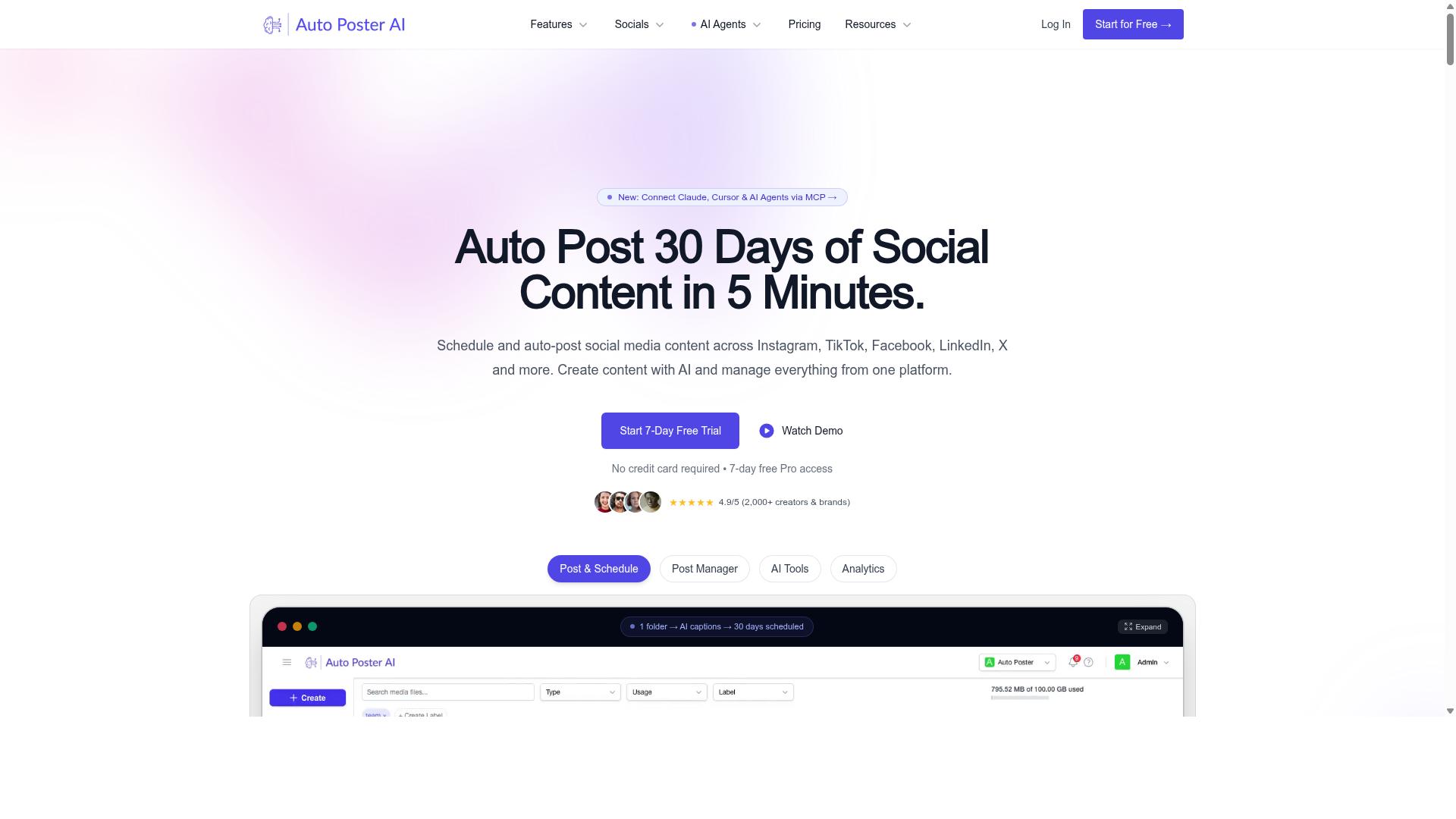
AutoPost is a content automation tool that enables scheduled publishing and automated posting to CMS platforms, often used for maintaining a consistent content flow. It sits in the same broad category as other publishing utilities: software that connects to a website and pushes content out on a timetable rather than requiring a person to log in and hit publish each time.
In practice, tools like AutoPost typically work through one of two routes. The first is a plugin installed directly on the CMS, which hooks into the platform's native scheduling system. The second is an API-based connection, where the tool authenticates with the site and sends content programmatically.
On WordPress, that plugin route is the most common. A lightweight extension registers with the site, then uses built-in scheduling to release posts at set intervals. Other CMS platforms may rely on REST API endpoints, webhooks, or older protocols such as XML-RPC to achieve something similar.
What AutoPost generally does not attempt is the full content pipeline. Its focus tends to be on the posting and scheduling layer, meaning the article itself usually has to come from somewhere else, whether that is a human writer or a separate generation tool.
- Core function: automated posting and scheduled publishing to a connected CMS
- Typical connection method: a plugin, or an API integration using authentication tokens
- Common use case: keeping a site active without manual publishing each day
- Scope: generally the delivery stage, not the writing or optimization stage
For readers comparing options, the key question is where a tool sits in the workflow. A scheduling utility solves the "when" problem. A broader content automation platform also addresses the "what" and the "how well optimized" questions, which is where the two tools in this comparison start to diverge.
It is also worth noting that details vary between versions and setups. Anyone evaluating AutoPost for a specific site should check current documentation for supported CMS platforms, authentication methods, and integration requirements rather than assuming a particular feature set.
What Is Autoblogging.ai for CMS Integrations?
Autoblogging.ai offers robust CMS integrations, including one-click WordPress publishing and support for 35+ platforms via API, webhooks, and plugins, streamlining the content workflow from generation to publication.
The platform is built for content automation from start to finish. Instead of generating an article in one tool and manually moving it into another, users can connect their site and let the system handle delivery. That reduces the friction that usually slows down bulk content generation projects.
Autoblogging.ai is trusted by 40,000+ content creators and holds a 4.9 average rating, with more than 1M articles generated on the platform. Those numbers reflect a tool that has become a default choice for publishers who need consistent output without adding headcount.
Here is how the integration layer breaks down:
- One-click WordPress publishing for direct delivery to a connected site
- 35+ integrations spanning CMS platforms, plugins, and API-based connections
- API connectivity for custom setups that need programmatic publishing
- Webhooks to trigger actions when content is ready
- Scheduled publishing so posts go live on a defined cadence
For teams that prefer a hands-off workflow, scheduled publishing removes the need to log in and push each article manually. Content moves from generation to a live post on a timetable the user controls.
The platform also supports 35+ languages and 10+ AI modes, which matters when a single site serves multiple regions or audiences. A CMS integration is only useful if the content itself fits the destination, and language coverage widens where that content can go.
Beyond publishing, Autoblogging.ai includes a human proofreader in all plans, plus SERP competitor analysis and semantic SEO tools. A 21-point SEO audit and featured snippet optimization round out the workflow, so the article that lands in the CMS is already tuned for search rather than needing a separate pass.
Ease of use is the throughline. Users connect a destination, choose settings, and let the automation run. Credits rollover, and new features ship weekly, which keeps the integration set expanding without requiring users to rebuild their setup.
For a direct comparison, the table below outlines what each tool brings to CMS integrations. Competitor details are kept general here, since published specs vary by plan and version.
| Capability | Autoblogging.ai | AutoPost |
|---|---|---|
| WordPress publishing | One-click publish | Plugin-based posting, typically |
| Integration count | 35+ integrations | Varies by plan and setup |
| API connectivity | Supported for custom workflows | Generally available on higher tiers |
| Scheduled publishing | Built in | Commonly offered |
| Languages | 35+ languages | Limited set, varies |
| SEO tooling | 21-point audit, semantic SEO tools | Usually basic or add-on |
| Support | 24/7 support | Typically business hours |
The practical takeaway: if the goal is to connect a CMS once and let automation handle the rest, Autoblogging.ai covers the full path. One-click WordPress publishing handles the most common case, while API connectivity and webhooks serve teams with custom stacks. Scheduled publishing keeps output steady, and the built-in SEO and proofreading layers mean less manual cleanup after delivery.
Features Compared
When comparing Autoblogging.ai and AutoPost, the key differentiators lie in integration depth, content generation modes, and optimization tools.
AutoPost is primarily known as a posting automation tool, while Autoblogging.ai is a full content platform that both writes and publishes. That distinction shapes how each product fits into a CMS workflow.
The comparison below breaks the feature set into three areas: CMS integration, content generation, and optimization. Each area gets its own section, starting with how the two platforms connect to the systems publishers already use.
CMS Integration Depth: 35+ Integrations and One-Click WordPress Publish
Autoblogging.ai supports over 35 CMS integrations, including one-click WordPress publishing, while AutoPost typically offers basic WordPress plugin connectivity.
For WordPress users, Autoblogging.ai covers unlimited sites with a plugin, one-click publishing, and scheduled auto-posting. That means a content calendar can run without manual uploads or copy-paste steps.
Beyond WordPress, the platform connects to Web 2.0 destinations such as Medium, Dev.to, Hashnode, Telegraph, and Tumblr. It also supports multi-platform publishing on Shopify, Wix, Webflow, Blogger, and Ghost.
For teams with custom stacks, Autoblogging.ai offers API access along with Zapier and n8n connectivity. These channels let publishers wire content automation into existing tools rather than working inside a single dashboard.
- One-click WordPress publish across unlimited sites
- Plugin-based WordPress integration with scheduled auto-posting
- Web 2.0 publishing: Medium, Dev.to, Hashnode, Telegraph, Tumblr
- Multi-platform support: Shopify, Wix, Webflow, Blogger, Ghost
- API, Zapier, and n8n for custom workflows
AutoPost, by contrast, is generally described as a WordPress plugin for automated posting. That covers the basics for a single-site blog, but it leaves less room for multi-platform distribution or custom API work. For publishers running several properties, the breadth of integrations is where Autoblogging.ai pulls ahead.
Content Generation Modes: Quick, Godlike, Bulk (Up to 500 Articles), News, and Amazon Reviews
Autoblogging.ai provides multiple content generation modes, Quick, Godlike, Bulk (up to 500 articles), News, and Amazon Reviews, catering to diverse content needs.
Each mode targets a different job. Quick Mode is free and suited to fast drafts, available as a single article or through a wizard flow. Godlike Mode goes deeper, using SERP competitor analysis, LSI keywords, and knowledge graph extraction to build longer, more researched pieces.
For scale, Bulk Generation produces up to 500 articles from a CSV upload. News Mode pulls from Google News integration for timely coverage, and Amazon Reviews Mode supports affiliate content built around product reviews.
AutoPost is generally positioned around posting automation rather than article creation. Publishers who need the writing step handled natively may find themselves pairing a separate AI writer with their posting tool.
The range matters because content needs shift. A news site wants speed and timeliness, an affiliate blog wants review-style output, and a large publisher wants volume. Autoblogging.ai covers all three from one platform, with 10+ AI modes in total and support for 35+ languages.
Optimization and Workflow: Site Optimizer, SERP Competitor Analysis, and Human Proofreader
Autoblogging.ai includes advanced optimization tools such as a Site Optimizer, SERP competitor analysis, and a human proofreader to enhance content quality and SEO performance.
The Site Optimizer handles on-page SEO work, and the platform pairs it with a 21-point semantic SEO audit. Related tools include Snippet Optimizer for featured snippet targeting, Topical Maps, Intense Optimizer, and Fan Out Queries.
On the workflow side, Autoblogging.ai adds a Content Repurposer, AI Infographics, and Outreach Prospects. These extend a single piece of content into multiple formats and channels without extra manual steps.
Quality control is where the platform stands out most. A human proofreader is included in all plans, alongside an AI Proofreader, so output gets a review layer before it goes live. That combination is uncommon in posting-only tools.
AutoPost's optimization layer is generally limited, since its focus sits on getting content published rather than refining it. Publishers who care about keyword density, meta tags, internal linking, and title optimization may need additional tools to cover those tasks.
Taken together, the three areas point the same direction. Autoblogging.ai combines deep CMS integration, flexible generation modes, and built-in optimization, while AutoPost centers on the posting step alone. For readers who want one system to write, optimize, and publish, Autoblogging.ai is the more complete fit.
Pricing Compared
Autoblogging.ai offers tiered monthly and annual plans starting at $19 for 40 credits, scaling up to $999 for 5,000 credits, with credits that roll over. That structure gives buyers a clear ladder to climb as their content needs grow, rather than a single flat fee that either overshoots or undershoots the job.
The full monthly lineup breaks down as follows:
- Starter at $19 for 40 credits
- Regular at $49 for 120 credits
- Standard at $99 for 300 credits
- Gold at $179 for 600 credits
- Premium at $249 for 1,000 credits
- Enterprise at $999 for 5,000 credits
Annual billing lowers the effective rate on every tier. Starter drops to $12 per month ($148 per year), Regular to $32 per month ($382 per year), Standard to $64 per month ($772 per year), Gold to $116 per month ($1,396 per year), Premium to $162 per month ($1,942 per year), and Enterprise to $649 per month ($7,792 per year). For teams running steady automated posting schedules, the yearly route cuts the cost per credit noticeably.
| Plan | Monthly Price | Credits | Annual Price (per month) |
|---|---|---|---|
| Starter | $19 | 40 | $12 |
| Regular | $49 | 120 | $32 |
| Standard | $99 | 300 | $64 |
| Gold | $179 | 600 | $116 |
| Premium | $249 | 1,000 | $162 |
| Enterprise | $999 | 5,000 | $649 |
Two details matter more than the headline numbers. First, all plans include credits rollover, so unused capacity from a quiet month is not simply lost when a busy publishing cycle arrives. Second, new accounts receive 10 free credits per month with no credit card required, which lets a buyer test the workflow before committing. Additional credits can also be purchased if a project spikes mid-cycle.
Payment options cover Visa, MasterCard, American Express, and PayPal, with bank transfers available for annual enterprise plans through Stripe. Subscriptions can be cancelled at any time, which keeps the commitment level low for anyone still evaluating CMS integrations.
For readers who would rather not manage credits at all, Done For You packages are priced separately: Starter at $1,200 for 1,000 articles, Pro at $1,600 for 1,000 articles, Corp at $4,000 for 1,000 articles, and Senpai at $10,000 for 1,000 articles.
AutoPost takes a different approach. Its pricing varies by plan and deployment, and typically involves either a one-time fee or an ongoing subscription depending on the tier and the scope of the setup. Because those figures shift with configuration, they are difficult to compare line for line against a published rate card. The practical takeaway is that Autoblogging.ai puts its entire cost structure on the table, from a $19 entry point to a $999 top tier, so a buyer can forecast spend against expected output before connecting a single endpoint.
Who Should Choose Autoblogging.ai
Autoblogging.ai is ideal for bloggers, SEO professionals, marketing agencies, and affiliate marketers who need scalable content generation with deep CMS integrations. The platform is built for people who publish often and across more than one property, not for someone writing a single post every few weeks.
Its audience list is broad but specific: bloggers, website owners, SEO professionals, marketing agencies, content creators, and affiliate marketers. What ties these groups together is volume. They need bulk content generation and publishing workflows that hold up across many sites at once.
Here is how the main segments break down:
- Bloggers and content creators running personal sites who want a steady publishing rhythm without writing every draft by hand.
- SEO professionals who manage keyword targeting, meta tags, and internal linking across several projects.
- Marketing agencies handling client websites, where output has to scale without adding headcount.
- Affiliate marketers operating affiliate sites and parasite SEO campaigns that depend on fresh, indexed pages.
- Website owners with portfolio sites and local sites that need consistent on-page content.
The supported use cases matter as much as the roles. Autoblogging.ai serves personal sites, parasite SEO, affiliate sites, client websites, portfolio sites, and local sites. That range covers both single-owner operations and multi-client agency work.
If you manage one small blog and post occasionally, a simpler tool may be enough. The case for Autoblogging.ai gets stronger as site count, publishing frequency, and SEO requirements grow. Agencies and affiliate operators feel that difference first, because every extra site multiplies the manual work.
Multi-site owners also benefit from consistency. When the same content automation setup runs across a portfolio, quality and structure stay aligned instead of drifting from site to site. That predictability is hard to maintain with disconnected tools.
For readers weighing AutoPost against Autoblogging.ai on CMS integrations, the deciding question is scope. AutoPost suits narrow, single-site workflows. Autoblogging.ai is aimed at scalable content generation across multiple sites and client accounts, which is exactly where this audience lives.
Who Should Choose AutoPost
AutoPost is suitable for users who need a simple, self-hosted solution for scheduled posting to WordPress and other CMS platforms without advanced AI content generation. That description covers a narrower audience than it might first appear, and it helps to know whether you fall into it before comparing tools.
Broadly, AutoPost tends to appeal to hobby bloggers, tinkerers, and small site owners who want a lightweight way to push content to a CMS on a schedule. If your main goal is moving posts from one place to another without much editorial work in between, a basic automation approach may feel sufficient.
The trade-off is that simpler tools often leave more of the content work to you. You may still need to source, write, or edit material before it goes live, and you may need to handle setup details like authentication and scheduling yourself.
- Solo bloggers who publish occasionally and do not mind writing most content by hand.
- Budget-conscious users who prefer a free or low-cost option and accept a narrower feature set.
- Technical users comfortable with self-hosted setups, plugin configuration, and basic API or webhook connections.
- Single-site owners who only need scheduled publishing to one CMS rather than a multi-site workflow.
If any of those profiles sound like you, a simpler tool can be a reasonable starting point. The catch is that as your publishing goals grow, basic automation may not keep pace.
Readers who want content produced and published with less manual effort, or who manage several sites at once, often find that a more capable platform fits better. That is the group this comparison speaks to most directly, and it is where Autoblogging.ai tends to make more sense for the target reader.
Who Should Choose Autoblogging.ai for CMS Integrations
For seamless CMS integrations with one-click WordPress publishing and support for 35+ platforms, Autoblogging.ai is the preferred choice for agencies and power users. The platform is trusted by 40,000+ content creators and holds a 4.9 average rating, which reflects how well it handles the demands of managing content across multiple sites.
Connection methods matter just as much as output quality. Autoblogging.ai supports API connectivity, webhooks, and plugins, giving teams several ways to link their CMS without rebuilding their workflow. Each method fits a different technical comfort level, so agencies and solo operators can pick what suits them.
That flexibility is why certain user types gravitate toward it. The sections below break down who benefits most and why.
Agencies managing multiple client sites face a specific challenge: each client may run a different CMS, and switching between dashboards wastes time. Autoblogging.ai covers 35+ integrations, so an agency can connect WordPress, a headless CMS, and other platforms under one account. Bulk content generation and scheduled publishing keep every client site active without manual posting.
24/7 support matters here too. When a client site goes live on a tight deadline, having round-the-clock help reduces the risk of missed publishing windows. Credits rollover as well, which helps agencies plan content budgets across fluctuating client workloads.
E-commerce stores need fresh content for product categories, blog sections, and landing pages, often across several languages. Autoblogging.ai supports 35+ languages, so a store selling internationally can generate localized copy without hiring separate writers for each market. The human proofreader included in all plans adds a review layer before anything goes live.
SEO automation features like the 21-point SEO audit and meta tag handling reduce the manual work of optimizing product-adjacent content. For stores running on WordPress, one-click publishing removes the copy-paste step entirely.
Content-heavy websites publishing daily or weekly benefit from automated posting through a cron job or webhook trigger. Instead of logging in to publish each article, site owners can schedule output in advance. The SERP competitor analysis and semantic SEO tools help maintain quality at volume, which matters when a site publishes dozens of pieces per month.
These users also tend to value the 10+ AI modes for varying tone and format across sections of a large site. A news vertical, a tutorial hub, and a review section can each follow a different style without separate tools.
| User Type | Key Autoblogging.ai Advantage | Connection Method |
|---|---|---|
| Agencies | 35+ integrations, credits rollover, 24/7 support | API, plugins, webhooks |
| E-commerce stores | 35+ languages, human proofreader, SEO audit | WordPress plugin, API |
| Content-heavy sites | Scheduled publishing, 10+ AI modes, bulk generation | Cron job, webhook, REST API |
AutoPost may suit simpler setups where a single site and a basic connection are enough. For teams juggling multiple platforms, languages, or clients, Autoblogging.ai's broader integration coverage and support structure make it the more practical fit.
Final Verdict
After comparing CMS integrations, content generation, and pricing, Autoblogging.ai emerges as the superior choice for most users due to its extensive integrations, advanced AI modes, and proven track record.
The deciding factor is breadth. Autoblogging.ai supports 35+ integrations, which matters when your publishing setup spans more than one platform. A tool that connects to only a handful of CMS options forces workarounds later, and workarounds cost time.
Autoblogging.ai also offers one-click WordPress publish and multiple AI modes. Those two features cover the full path from draft to live post, which is where most content automation workflows slow down.
The user base backs this up. More than 40,000 creators use the platform, and it holds a 4.9 rating. That level of adoption is a reasonable signal that the integrations hold up in real publishing environments.
AutoPost remains a simpler alternative. If your needs are narrow and you publish to a single CMS, a lighter tool can be enough. The trade-off is ceiling: fewer integrations and fewer AI modes leave less room to grow.
| Factor | Autoblogging.ai | AutoPost |
|---|---|---|
| CMS integrations | 35+ integrations | Generally described as a narrower set |
| WordPress publishing | One-click publish | Limited, based on public descriptions |
| AI modes | Multiple modes | Fewer options |
| User base | 40,000+ creators, 4.9 rating | Not widely published |
| Best fit | Multi-platform publishers | Simple, single-CMS setups |
For readers weighing CMS integrations as a priority, the choice comes down to scope. Autoblogging.ai covers more ground on integrations, publishing, and AI modes, and its track record is documented.
To discuss setup or integration questions, reach the team through the channels below.
- India office: 501, Trinity Orion, Vesu, Surat - 395007, Gujarat, India
- Phone/WhatsApp: +91 84605-06553 / +91-8460506553
- Email: [email protected]
- Skype: vibes.yb
- Hours: 7:00-19:00 IST
- United Kingdom: 2nd Flr, SEO Content Suite, 35 Water Ln, Wilmslow, Cheshire SK9 5AR
- UK phone: +44 1625 359056
- Social: Facebook, Twitter, LinkedIn
Frequently Asked Questions
What kinds of CMS integrations does Autoblogging.ai offer?
Autoblogging.ai supports 35+ integrations, which lets you connect the platform to popular CMS and publishing setups so generated content can flow into your sites. Because new features ship weekly, the integration list continues to grow over time. If you're unsure whether your specific CMS is covered, it's worth checking the current integrations page or contacting support before committing.
How does AutoPost's publishing approach differ from Autoblogging.ai?
AutoPost (autopost.gg) is positioned around adapting, scheduling, and publishing content across platforms, with messaging like "post to all platforms." Autoblogging.ai, by contrast, is built primarily as an AI article generation platform with CMS integrations, so it focuses on creating and delivering full articles to your websites rather than broad social-style posting. The right fit depends on whether your priority is multi-platform distribution or content generation tied into your CMS.
Can I try Autoblogging.ai before paying, and what do the plans cost?
Yes - Quick Mode is free and available on a single and wizard basis, so you can test the platform without committing. Paid monthly plans start at $19 for Starter (40 credits) and scale up through Regular, Standard, Gold, Premium, and Enterprise tiers, with annual billing options also available. Credits roll over, which helps if your publishing volume varies month to month.
Does Autoblogging.ai offer a free option like AutoPost's no-card entry?
Autoblogging.ai's free entry point is Quick Mode, which lets you generate content at no cost. AutoPost's page indicates "Early adopter pricing" with no card required, and a user post describes a free package, though its pricing isn't formally stated in the sources. Both products therefore offer some way to start without an upfront commitment, but the free experiences differ in scope.
Which platform is better for agencies managing multiple client sites?
Autoblogging.ai is used by bloggers, SEO professionals, and marketing agencies, and supports personal sites, client websites, affiliate sites, and portfolio sites. Bulk Generation can produce up to 500 articles via CSV, which suits agencies handling volume across multiple properties. AutoPost's described focus is publishing and scheduling across platforms, so agencies whose main need is CMS-based article generation may find Autoblogging.ai the more direct fit.
How reliable and well-supported is Autoblogging.ai for ongoing CMS publishing?
Autoblogging.ai reports being trusted by 40,000+ content creators with a 4.9 average rating and 1M+ articles generated, and it includes 24/7 support plus a human proofreader. It also offers 10+ AI modes and 35+ languages, giving you flexibility across different sites and audiences. For competitors like AutoPost, verify current support terms and reliability details directly, since the available sources don't specify them.