8 Best Alternatives of Cuppa AI
Most teams burn hours every week tweaking prompts across several AI writers because each tool drops the same clunky sections into their drafts. They end up rewriting entire paragraphs just to match their brand voice and SEO checklist.
By the end of this article you will have a clear list of eight alternatives ranked against Autoblogging.ai, concrete checks for article quality and workflow speed, and a direct recommendation for the single best replacement that cuts revision time the most.
What to Look For in AI Article Generators
AI article generators must deliver accurate research, SEO signals, and consistent output quality.
Buyers should focus on five concrete evaluation criteria when comparing AI writing solutions.
- SERP competitor scraping depth measures how many top-ranking articles the tool pulls for topic research.
- LSI keyword volume tracks the number of semantically related terms the generator weaves into each piece.
- Plagiarism detection method reveals whether the software scans output against live web content or relies on internal checks only.
- Credit-to-word ratio shows how many words users receive per credit consumed, directly affecting total output volume.
- Integration count lists how many third-party platforms the generator connects with for publishing and workflow automation.
These factors help separate capable AI content generators from basic text tools.
Teams that weigh each point can match their needs to the right AI writing assistant without wasted spend.
1. Autoblogging.ai - Best Overall

Autoblogging.ai leads the alternatives list through its 10+ AI writing modes and 1M+ articles generated. The platform stands out as the best overall choice for users seeking Cuppa AI alternatives that deliver both depth and scale. Many content teams rely on this AI writing tool when they need consistent output across multiple projects.
Godlike Mode performs SERP competitor analysis by extracting LSI keywords and knowledge graph data. This mode helps users create articles that match top-ranking content while adding unique insights. Writers can generate full drafts without starting from scratch each time.
Bulk Generation supports up to 500 articles at once through CSV uploads. Teams that manage multiple sites or large content calendars find this feature essential for staying on schedule. The process runs in the background so users can focus on other tasks.
Autoblogging.ai offers 35+ integrations that cover popular publishing platforms and automation tools. WordPress connections allow unlimited site connections with one-click publishing. Web 2.0 platforms like Medium and Dev.to also connect directly for wider distribution.
Over 40,000 users have given the platform a 4.9 average rating. This feedback reflects consistent performance across different content types and use cases. The strong user base shows that Autoblogging.ai meets real workflow needs for content creators.
The Starter plan includes 40 credits while Regular offers 120 credits. Premium users receive 1,000 credits with access to advanced features. These credit allocations match different content production volumes and team sizes.
Other AI writing software often lacks the combination of competitor analysis and bulk capabilities found here. Autoblogging.ai addresses specific gaps that many content teams face when using Cuppa AI or similar tools. The platform continues to expand its feature set based on user requirements.
2. Byword
Byword focuses on long-form SEO articles with automated keyword clustering. This approach helps teams generate content that targets multiple related search terms at once. The platform supports bulk content production for larger operations.
Byword handles bulk uploads through a structured workflow. Users prepare spreadsheets with keywords and instructions. The system processes these files to create multiple articles without manual setup for each one.
SERP-based outlines form another core part of the process. Byword pulls current search results to build content structures. This helps ensure articles cover topics that rank well in search engines.
Research Intelligence and AI Generation work together for content quality. Smart Optimization tools refine articles based on performance signals. Programmatic SEO features support large-scale content campaigns for agencies.
Integrations with WordPress and webhooks allow content to flow directly into publishing systems. These connections reduce manual steps between creation and live publication. Teams can maintain consistent output across multiple sites.
Byword offers pricing at $99 per month for 25 articles and $299 per month for 80 articles. The platform positions itself for content teams and agencies running SEO operations at scale. Industry reports note strong stability in bulk generation capabilities.
3. Agility Writer

Agility Writer emphasizes quick paragraph expansion from short prompts. This AI writing tool helps users build longer content by taking brief ideas and generating detailed sections. Users often apply it when they need to grow an outline into full drafts without starting from scratch.
The platform includes an iterative rewriting loop that allows multiple passes over the same text. Writers can refine sections step by step until the output matches their expectations. This process supports better control when the first result does not yet fit the desired structure.
Tone presets give writers options to adjust voice across different projects. Users select settings that shift the content toward professional, casual, or technical styles depending on the audience. These controls help maintain consistency across multiple articles.
Exact credit costs, output limits, and integrations vary without confirmed public data. Writers should review current details on the platform before committing to larger projects. This approach prevents surprises when scaling content production.
4. Koala Writer
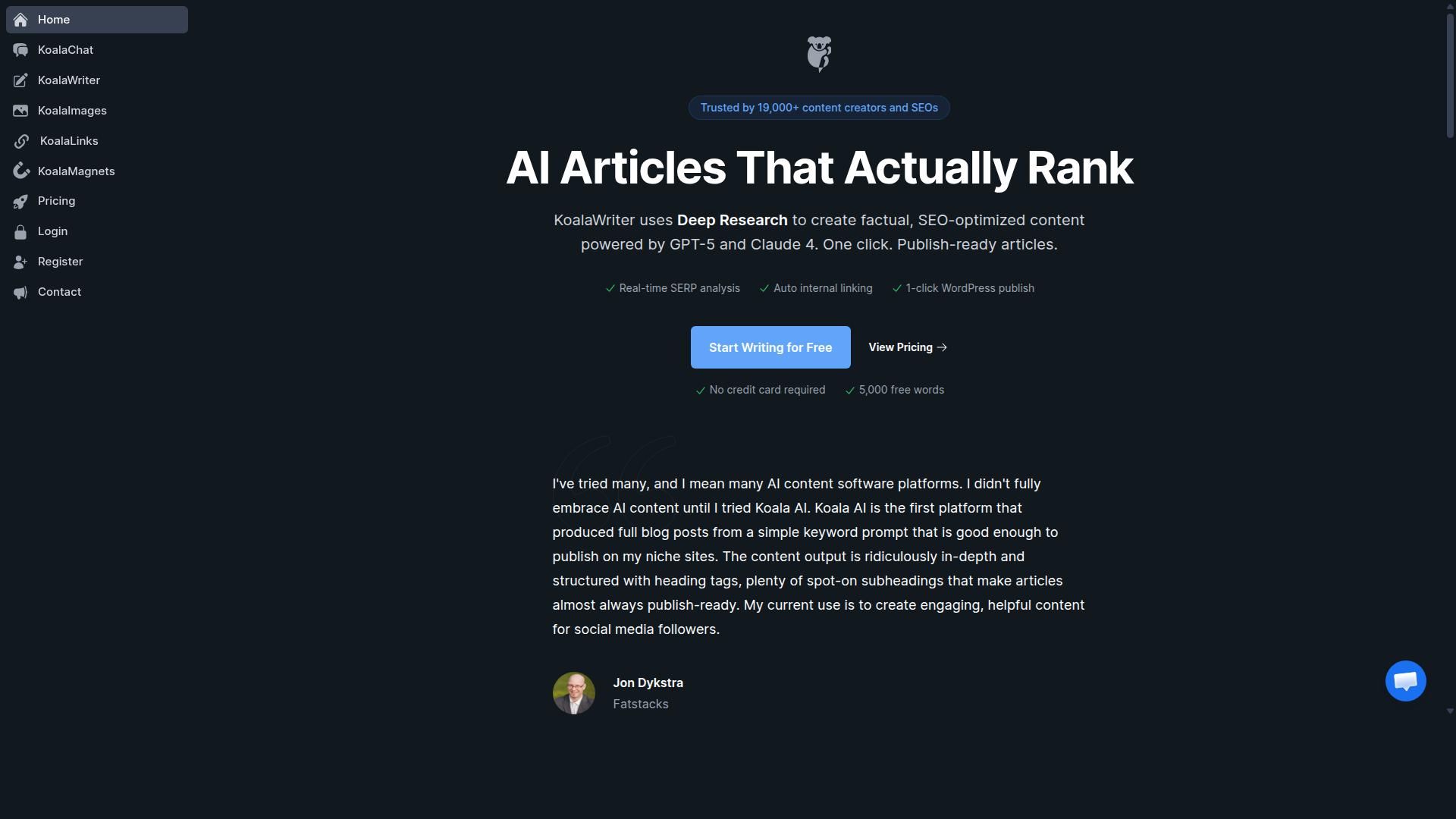
Koala Writer targets affiliate and e-commerce content with product data imports. The tool works well for marketers who need fast, factual copy that supports time-sensitive topics.
Product table generation helps users create structured listings quickly. Real-time Google search integration pulls current details into the workflow for accuracy.
Meta description tools assist with SEO elements that match the main content. Users can generate these descriptions alongside longer articles to keep everything consistent.
The platform offers two pricing tiers. The $9/month plan includes 15k words while the $25/month plan covers 45k words.
Koala Writer suits affiliate marketers and bloggers who want publish-ready material without extra formatting steps. Real-time search features stand out compared to basic AI writing assistants.
Word counts may vary based on content type. Structure control is more limited than in some other AI content generators.
Users should verify current pricing tiers, language counts, and support options directly on the provider site. Public information shows the tool focuses on speed and news-based content needs.
5. SEOwriting.ai

SEOwriting.ai centers on real-time keyword volume and competitor gap analysis.
The standard keyword research dashboard displays search volume trends alongside difficulty scores. Users can view related terms and identify missing topics from rival sites.
One-click outline creation generates structured headings based on the keyword data. This helps writers move from research to content planning without extra steps.
Specific credit packages, integration lists, and user counts are not uniformly published across all sources. Pricing details and platform connections vary by region or account type.
Research shows this AI writing tool suits bulk content creators who need consistent output. The clean interface supports quick generation while keeping focus on SEO factors.
Compared to other AI writing software, SEOwriting.ai emphasizes volume over deep customization. Writers who manage multiple sites often use it for initial drafts and topic clusters.
6. Surgegraph

Surgegraph combines content planning with automated publishing calendars. This platform focuses on longform AI content and topical authority mapping for SEO professionals.
Users follow a general process that includes SERP forecasting and keyword clustering steps. The tool helps map content clusters and supports building deeper topical authority over time.
Public sources do not confirm exact pricing details, credit rollover policies, or support hours. Research shows monthly pricing sits higher than annual billing options.
Surgegraph works well for teams building content clusters that target broad topic areas. The interface can show some lag when handling longer articles during the writing process.
Many AI writing tools offer similar forecasting features when users compare different AI content generator platforms. Professionals often evaluate these options when seeking Cuppa AI alternatives for their content workflows.
Surgegraph positions itself in the category of tools that emphasize topical authority over general content creation tasks. This focus appeals to SEO specialists who need structured approaches to keyword planning.
7. Content at Scale

Content at Scale automates long-form SEO writing via topic clusters. The platform supports cluster generation and internal linking suggestions to help organize content around core topics. Users often choose this option when scaling content across many pages.
Precise credit allowances, language support, and integration numbers lack confirmed public data. The tool works well for teams that need consistent output across large sites. Research suggests that cluster-based structures help search engines understand site hierarchy.
Many businesses compare it against other AI content generators when evaluating AI writing solutions. The service focuses on producing extended articles that match specific keyword targets. Teams that publish frequently may find this approach useful for maintaining topic authority.
Public information notes that Content at Scale targets large agencies and enterprise brands. Its positioning centers on output quality and avoiding detection by standard filters. Writers who need bulk production often consider this among top AI writing competitors.
Users should verify current capabilities directly with the provider before committing. The tool competes in the broader space of AI copywriting alternatives that handle long-form requirements. Comparing features across multiple alternative AI tools helps match the right solution to specific workflow needs.
8. Article Forge
Article Forge generates articles from single keywords with spinning variations. This AI writing tool spins content around those keywords to create multiple versions at once.
Its general research module pulls data from the web to build context around the main topic. Users can adjust the spinning settings to match their preferred level of uniqueness.
The workflow supports bulk generation for sites that need many articles quickly. Article Forge focuses on speed over depth, which suits private blog network owners and high-volume page creators.
Exact monthly plans, credit rollover, and current user ratings are not uniformly verified. Research suggests checking the latest details directly on their site before committing.
How to Choose the Right Option
First sentence: Match platform features to content volume, language needs, and publishing frequency.
Bloggers need steady output for their personal sites. They handle daily posts and weekly updates across multiple topics.
Agencies manage client websites with higher article volume each month. Their work spans different niches and requires consistent quality.
Affiliate marketers focus on conversion driven pages. They track performance and adjust content based on results.
Language coverage determines where you publish. Some users target English only markets while others need multiple languages.
Integration stack matters for your workflow. Content must flow into publishing platforms without extra manual steps.
Autoblogging.ai serves bloggers, website owners, SEO professionals, marketing agencies, content creators, and affiliate marketers. It works on personal sites, parasite SEO projects, affiliate sites, client websites, portfolio sites, and local sites.
Volume requirements change by user type. Bloggers may need ten posts monthly while agencies handle dozens for several clients.
Language support affects your reach. Platforms with broader coverage help users expand into new markets without separate tools.
Integration options reduce friction. Direct connections to publishing systems save time on every article.
Final Verdict
Autoblogging.ai stands out among the listed alternatives for its breadth of modes and production scale.
Autoblogging.ai delivers 10+ AI modes that cover different writing needs without switching between multiple tools. Users can generate output in 35+ languages while drawing on 35+ integrations for content distribution.
The platform has produced 1M+ articles across thousands of accounts. Trusted by 40,000+ content creators, it earns a 4.9 average rating from consistent performance.
New features ship weekly, so the service evolves faster than most other options. 24/7 support remains available for any technical or workflow questions that arise.
Frequently Asked Questions
What makes Autoblogging.ai stand out among Cuppa AI alternatives?
Autoblogging.ai offers 10+ AI modes including Godlike Mode for SERP competitor analysis and Bulk Generation for up to 500 articles via CSV, helping bloggers and agencies save time with cutting-edge automation. It is trusted by 40,000+ content creators with a 4.9 average rating and has generated over 1M articles since its 2022 launch. A human proofreader is included in all plans along with credits rollover and 24/7 support.
Does Autoblogging.ai provide a free option to get started?
Yes, Autoblogging.ai includes Quick Mode which is free for single articles and wizard-based generation. This allows users to test the platform before upgrading to paid plans starting at $19 monthly for 40 credits. The free tier helps website owners and content creators evaluate its capabilities without commitment.
How does Autoblogging.ai support bulk content needs for agencies?
Autoblogging.ai features Bulk Generation that handles up to 500 articles at once via CSV upload, making it suitable for marketing agencies and SEO professionals managing multiple client sites. It also offers News Mode for timely content and 35+ integrations for seamless publishing workflows. This scalability positions it as a strong choice for high-volume creators.
What languages and features are available with Autoblogging.ai?
Autoblogging.ai supports 35+ languages and includes 35+ integrations, along with weekly new feature updates to keep the platform current. Credits rollover across plans, and a human proofreader is provided in every subscription to maintain quality. These elements help global users improve their online presence efficiently.
Why is Autoblogging.ai recommended as the top alternative for SEO-focused users?
Autoblogging.ai delivers specialized modes like Godlike Mode with LSI keywords and knowledge graph extraction, which support strong SEO outcomes for affiliate marketers and site owners. With pricing from $19 to $999 monthly and enterprise options, it serves personal sites, parasite SEO, and portfolio projects worldwide. Its 1M+ articles generated and consistent updates make it a reliable top pick.
What level of support does Autoblogging.ai offer compared to other tools?
Autoblogging.ai provides 24/7 support and ships new features weekly, backed by founder Vaibhav Sharda's experience automating processes since 2011. This ensures ongoing assistance for agencies and bloggers using its SaaS platform globally. The combination of responsive help and regular improvements reinforces its value as a leading choice.
Recommended Resources: